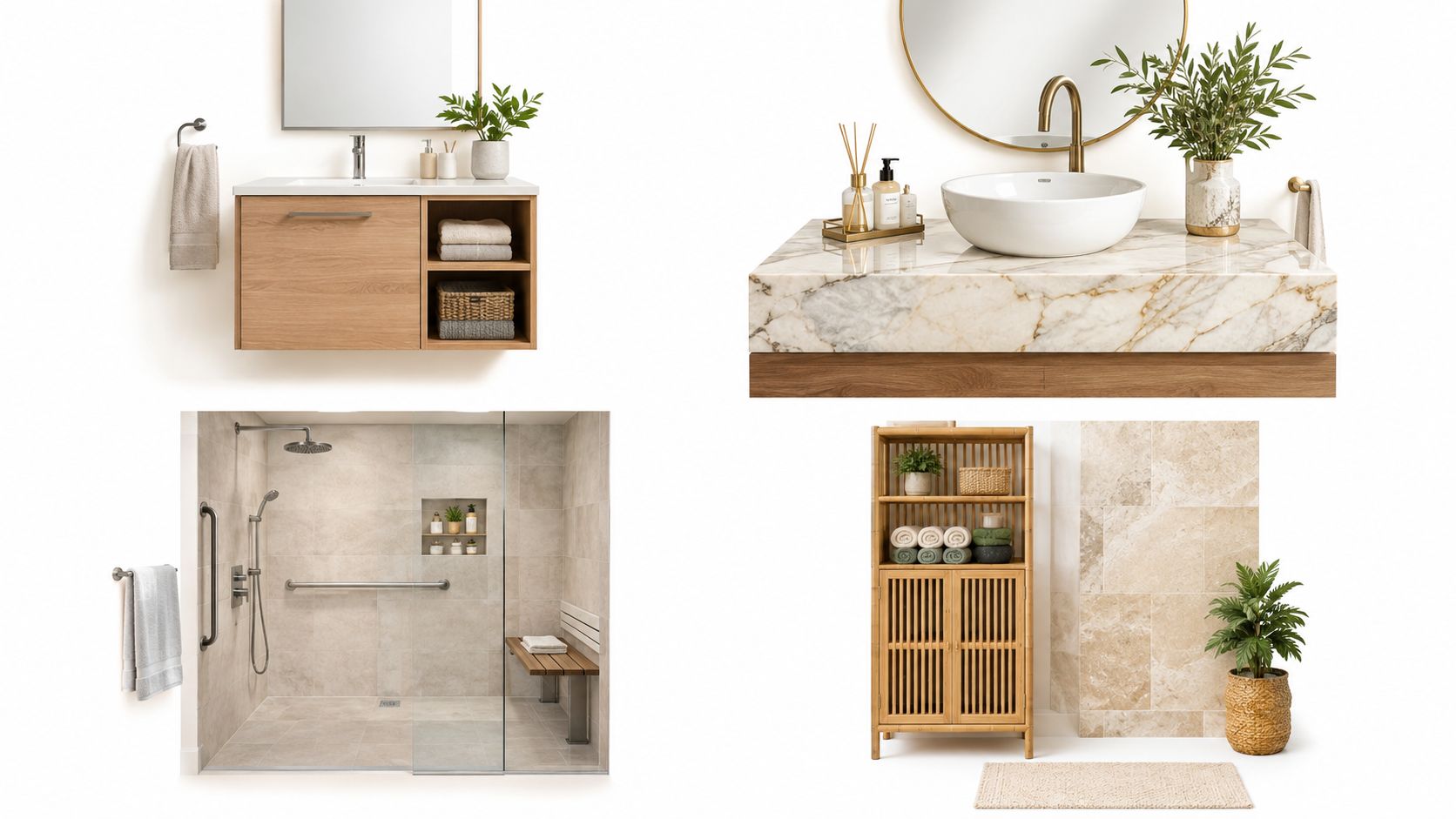
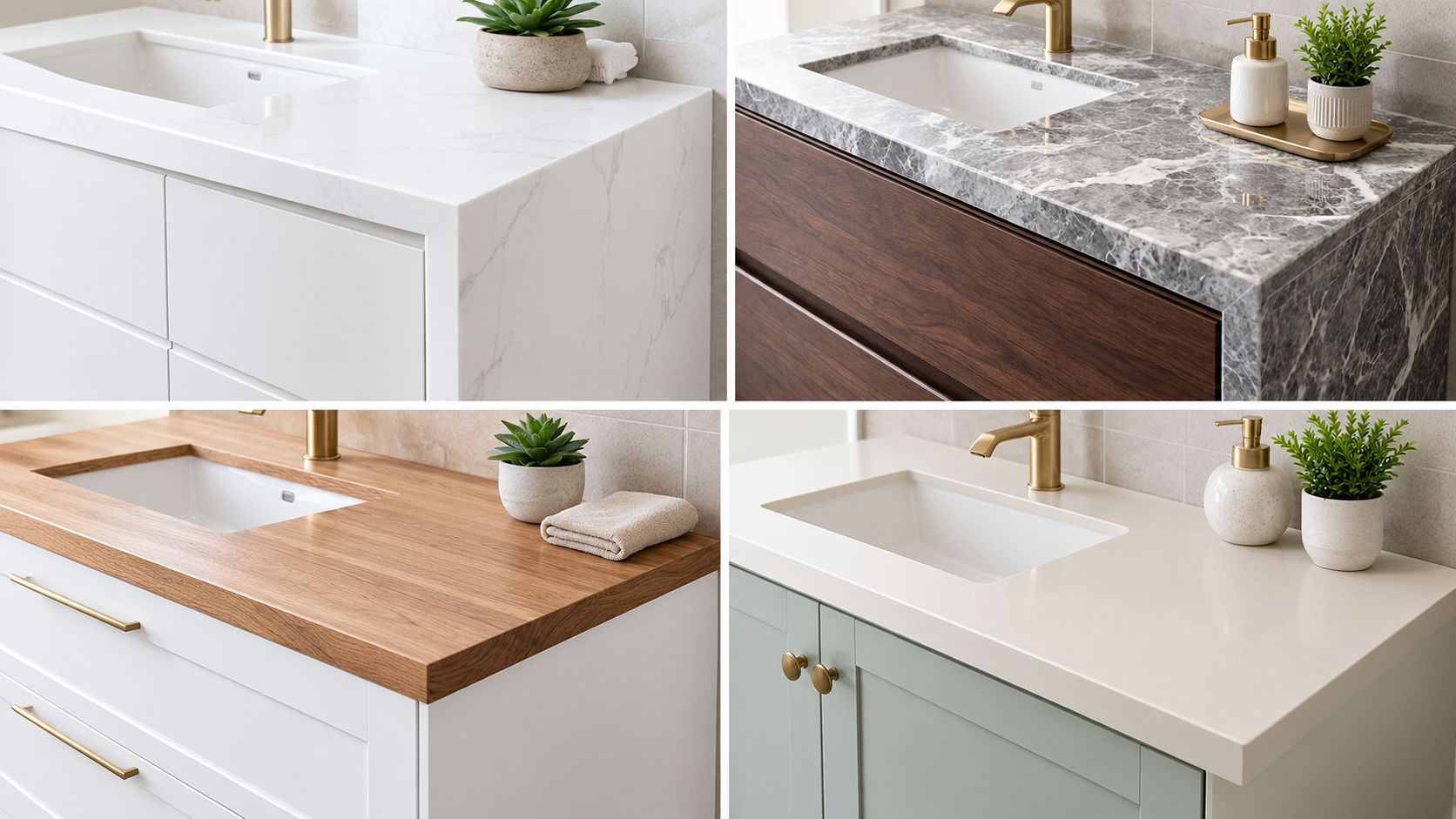
A bathroom vanity in Cherry Hill or nearby South Jersey has to do more than look good in a tile sample. It needs to coordinate with cabinetry, hardware, lighting, and backsplash material while handling moisture, cosmetics, cleaning products, and hot styling tools every day. The right surface depends on your budget, preferred design language, tolerance for maintenance, and whether you're updating a powder room, guest bath, or heavily used primary suite.
These countertop ideas for bathroom design cover four core materials, plus installation and design approaches that can change the final appearance and performance. Engineered quartz may suit a busy household, while marble can create a more expressive focal point. Solid surface, porcelain, laminate, waterfall edges, integrated sinks, and mixed materials each solve different problems. Even your home's water conditions can affect broader plumbing planning, so coordinate countertop decisions with the rest of the renovation rather than treating the vanity as an isolated purchase. For related household plumbing planning, see this guide to San Antonio water softener installation.
Table of Contents
- 1. Quartz Engineered Stone Countertops
- 2. Marble and Granite Natural Stone Countertops
- 3. Solid Surface Countertops
- 4. Waterfall Edge Installation Approach
- 5. Porcelain Slab Countertops
- 6. Laminate Countertops
- 7. Integrated Undermount Sink Installation
- 8. Mixed-Material Countertop Approach
- 8-Point Bathroom Countertop Comparison
- Choose the Surface That Fits Your Routine
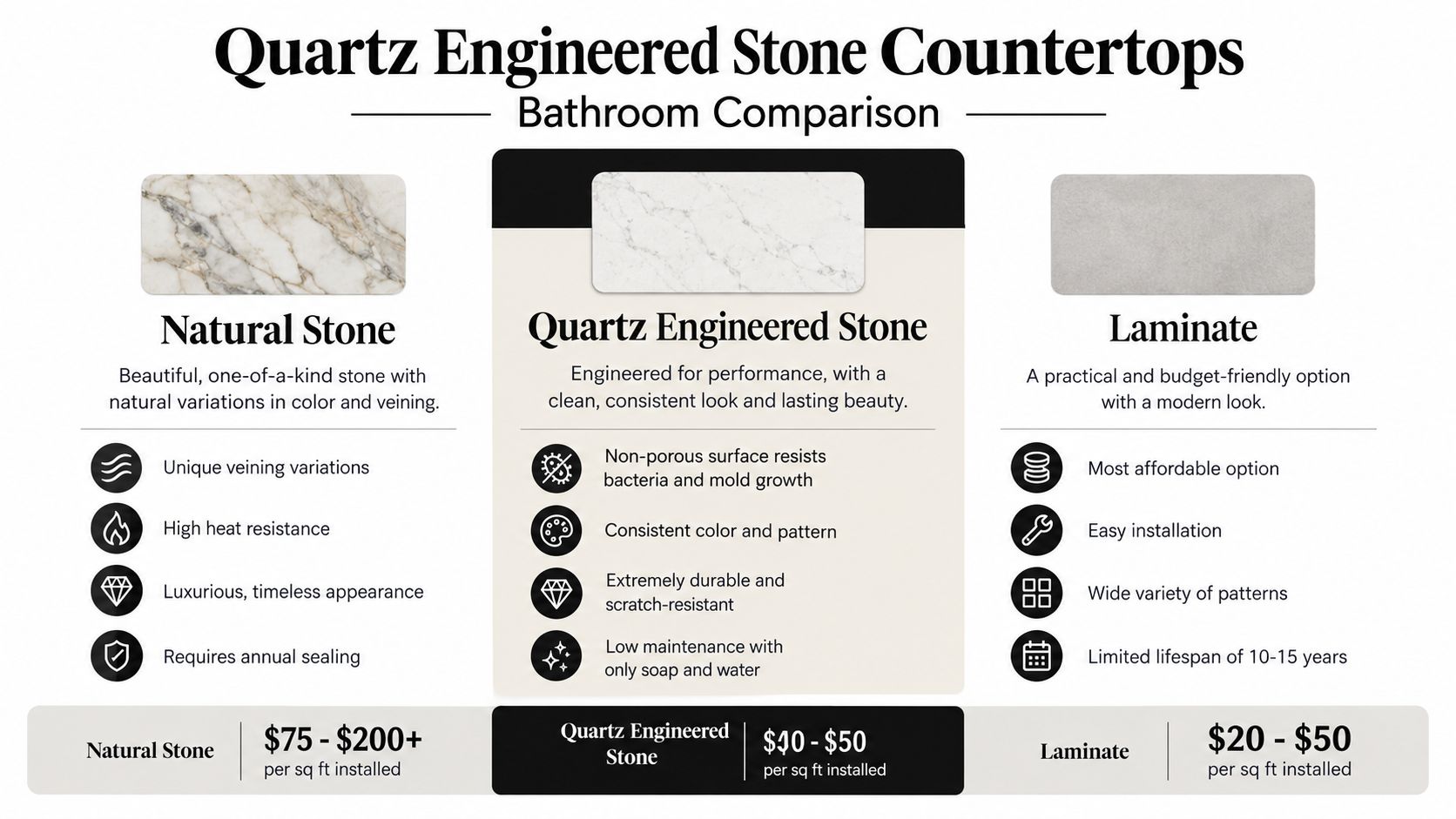
1. Quartz Engineered Stone Countertops
Engineered quartz remains one of the most practical choices for a South Jersey bathroom vanity. The 2024 U.S. Houzz Bathroom Trends Study reports that 42% of homeowners selecting a new vanity countertop chose engineered quartz, ahead of quartzite at 20%, granite at 15%, and marble at 13% in the Houzz bathroom trends study. That makes quartz a useful starting point when you want a surface that looks custom without demanding the sealing routine associated with many natural stones.
Quartz works particularly well with white, greige, navy, and natural-wood cabinets. A soft veined slab can echo marble in a traditional Cherry Hill primary bath, while a charcoal or mottled design can give a contemporary vanity more depth and help disguise water spots or toothpaste residue. Brands such as Caesarstone, Silestone, and LG Viatera offer patterns ranging from quiet solid colors to dramatic stone effects. For additional material context, compare the design and application considerations in this guide to quartz kitchen work surfaces, remembering that a bathroom still needs its own sink, splash, and storage planning.
Where quartz succeeds and where it needs care
Quartz is moisture-resistant and easy to clean, but it isn't indestructible. Hair straighteners, curling irons, and other hot tools shouldn't sit directly on the slab. Use a heat-resistant mat, even in a luxury bathroom. The material is also heavy, so the cabinet must be level and adequately supported before templating.
Practical rule: Choose the quartz pattern after viewing a full sample in the actual bathroom. Small showroom samples can hide how veining will fall around the sink and backsplash.
Ask the fabricator about seam placement, sink cutouts, edge profiles, and wall irregularities. A beveled or eased edge usually suits a clean transitional vanity, while an ogee profile can support more traditional cabinetry. Daily cleaning should stay simple, with a soft cloth and a cleaner suitable for the manufacturer's finish. Abrasive products and improvised chemical mixtures can dull the surface over time.
2. Marble and Granite Natural Stone Countertops
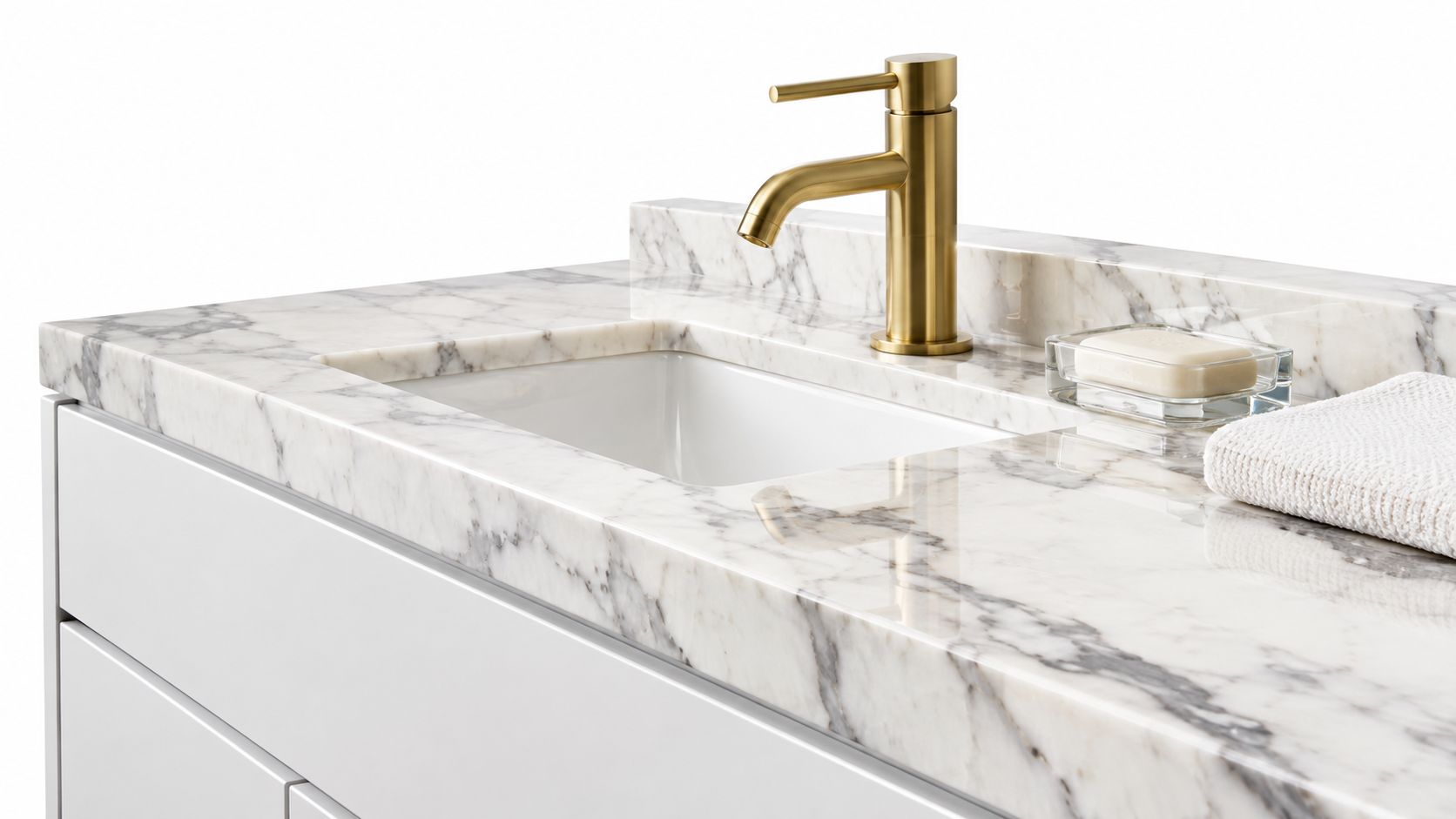
Natural stone brings variation that engineered materials intentionally control. Marble offers soft movement and distinctive veining, making it a strong choice for a traditional or transitional vanity with painted cabinets, polished nickel, brushed brass, or classic tile. Granite generally brings a denser visual character, from quiet light backgrounds to dark surfaces with mineral flecks that work well against white cabinetry and stainless or matte-black fixtures.
A Carrara marble top can anchor a calm primary bathroom when the same stone appears selectively in the shower niche or wall tile. In a Camden County renovation, a darker granite might provide the visual weight needed to balance pale cabinets and patterned floor tile. The material should fit the room's maintenance habits, not just its inspiration image. Homeowners who want the look of marble but don't want every cosmetic spill to become a concern may prefer quartz or another lower-maintenance surface.
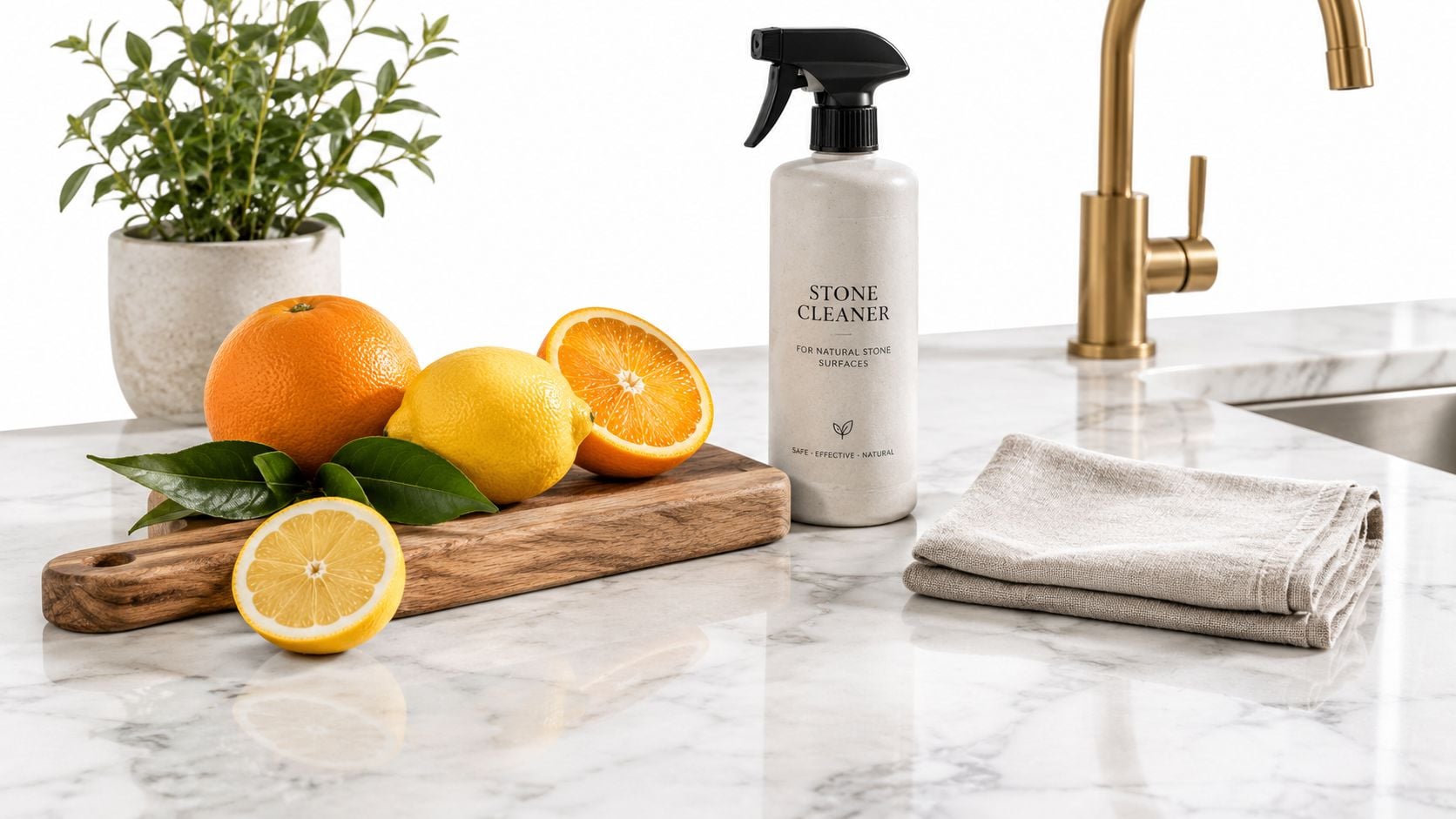
Natural stone requires a more deliberate care plan. Seal the surface according to the fabricator's recommendation, use a pH-neutral stone cleaner, and wipe up products that may etch or stain, especially on marble. Good exhaust ventilation also matters because persistent humidity affects the whole vanity area, including cabinet interiors and wall finishes.
Match the finish to the household
Polished stone reflects light and can make a compact bathroom feel brighter, but it may show water marks more readily. Honed or leathered finishes offer a softer appearance and can make minor marks less visually prominent. They also change the way the stone feels beside glossy tile and reflective hardware.
- Marble for expression: Select it when veining is central to the design and the household accepts regular care.
- Granite for contrast: Use a darker or more patterned slab when the room needs a grounded focal point.
- Stone with quartz: Keep natural stone in a feature zone and use quartz elsewhere when you want to balance character with easier maintenance.
For a focused discussion of stone selection and vanity applications, see these marble bathroom countertop options. The best slab is the one whose care requirements match how the bathroom is used.
3. Solid Surface Countertops
Solid surface, including Corian and comparable acrylic-based products, is a smart option when you want the vanity to read as one continuous form. The material can be fabricated with discreet seams and shaped for custom edges, backsplashes, and integrated basins. That makes it particularly useful in smaller South Jersey bathrooms where a busy pattern could make the room feel crowded.
A white or warm-gray solid-surface top pairs naturally with flat-panel cabinets, slab tile, and simple hardware. Add wood-tone cabinetry or a textured wall tile to keep the room from feeling too clinical. In a family bathroom, an integrated sink can eliminate the rim around a drop-in basin and make daily wiping easier. The result is less about showing off a dramatic slab and more about creating a quiet, functional vanity.
Plan the sink before the slab
The biggest advantage of solid surface can disappear if the sink decision comes too late. Specify the basin, faucet location, backsplash, and edge profile together so the fabricator can resolve seams and transitions cleanly. A rounded edge softens a modern cabinet, while a crisp bevel adds definition without the visual weight of a thick stone profile. The material can also support custom-shaped counters where a standard rectangular top won't use the room efficiently.
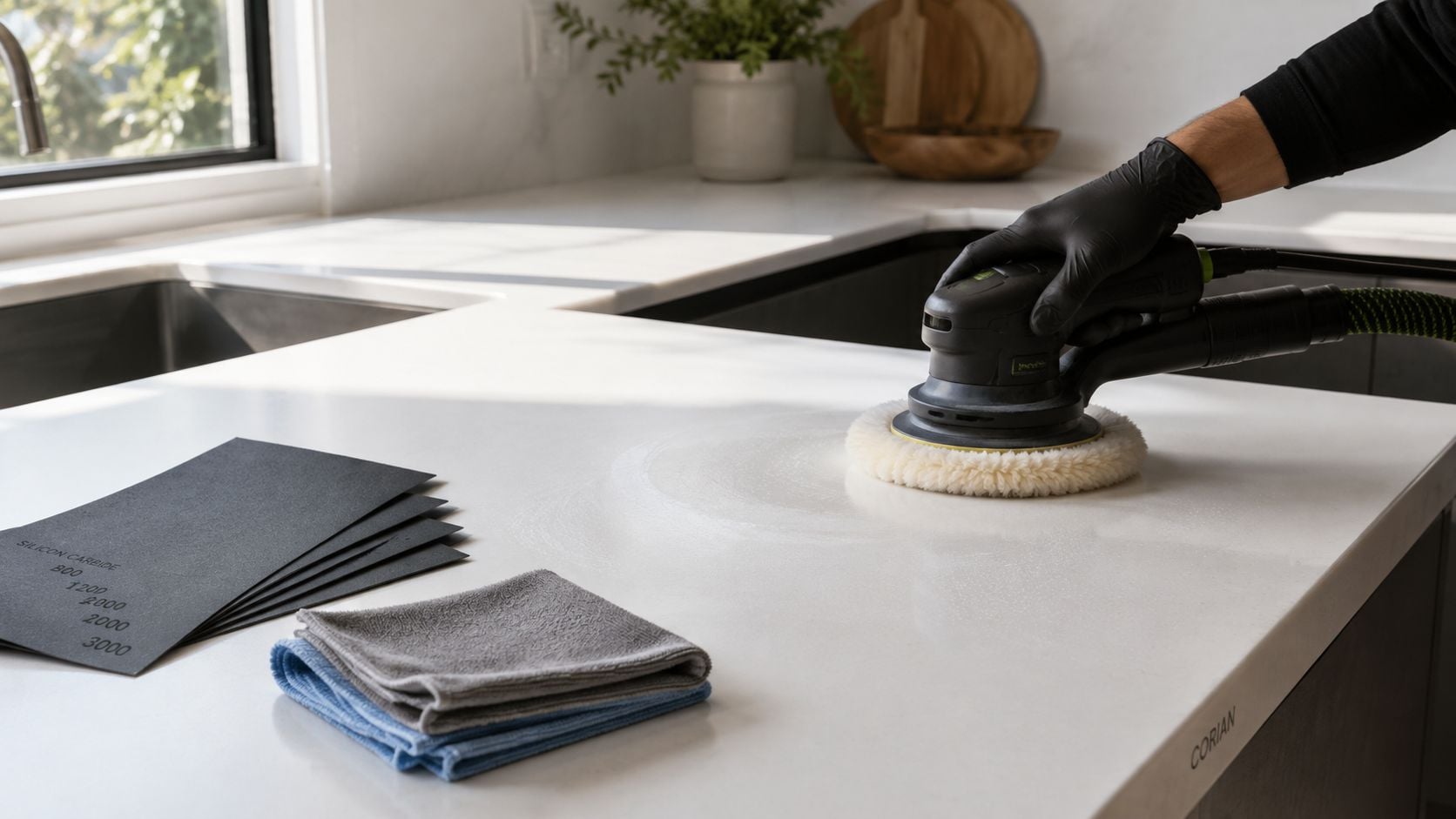
Read this explanation of what Corian countertops are before comparing samples and fabrication options. Pay close attention to the finish under your bathroom lighting. Glossy surfaces can feel brighter, while matte finishes often create a calmer, more contemporary effect.
Solid surface still needs reasonable care. Use a soft cloth and non-abrasive cleaner, keep hot tools on a mat, and avoid treating the counter as a cutting or repair surface. Light wear may be refinished by a qualified professional, which can extend the useful life of the vanity. That repairability is valuable in a rental, guest bath, or family bathroom where a pristine surface isn't always realistic.
4. Waterfall Edge Installation Approach
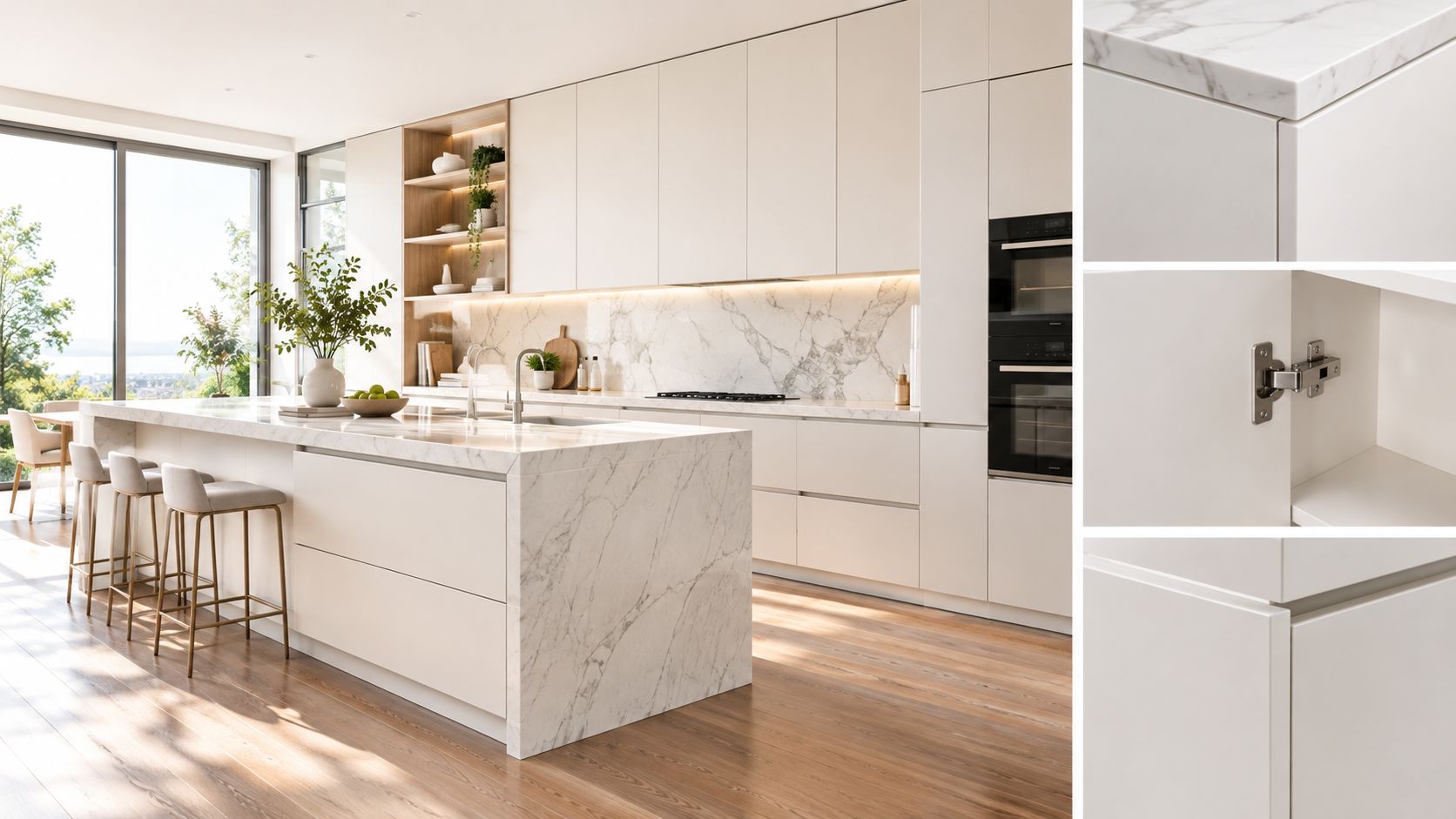
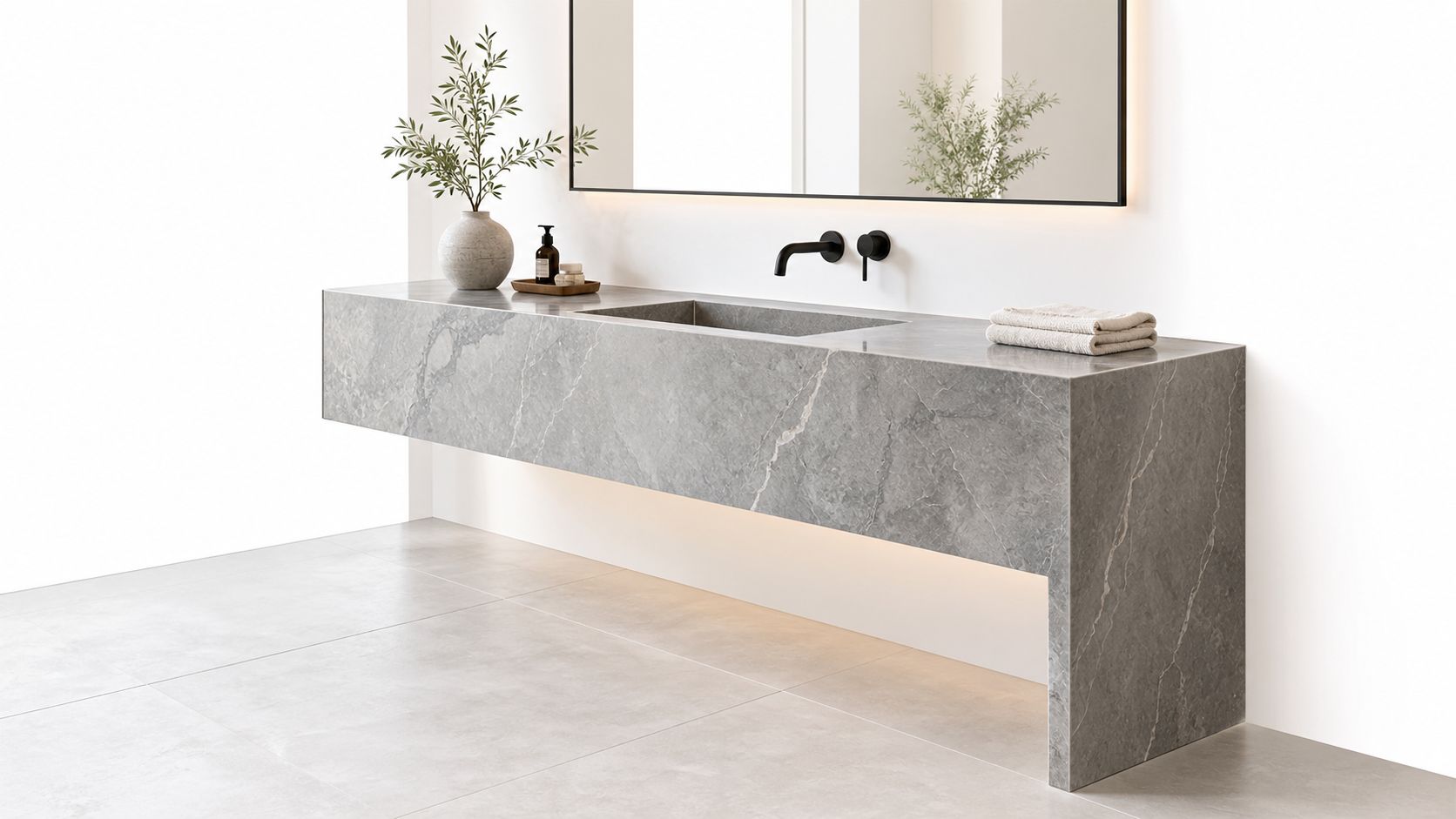
A waterfall edge changes the countertop from a horizontal plane into a piece of built-in architecture. The slab continues down the exposed side of the vanity, either to the floor or to a planned stopping point, creating a strong vertical line. This approach can make a floating or furniture-style vanity feel more substantial, and it works with quartz, granite, marble, porcelain, and other fabricable surfaces.
The detail is most effective when the side of the cabinet is visible from the bathroom entrance. On a narrow vanity tucked against a wall, the added material may contribute little while complicating installation. In a larger Cherry Hill primary bath, a waterfall side can frame the vanity and coordinate with the flooring, shower bench, or a nearby freestanding tub.
Detail and support determine the result
A waterfall edge isn't just an extra strip attached to the side. The fabricator must align the pattern, create a clean mitered corner where appropriate, and account for cabinet dimensions, floor conditions, outlets, and access. Heavy material also needs a cabinet structure designed to carry the load. Before ordering, confirm the finished height, exposed side, edge thickness, and how the bottom terminates near the floor.
Use a waterfall edge sparingly in a small bathroom. It can visually narrow the vanity and make storage access feel tighter if the side blocks a drawer or door. It also makes more sense on a well-finished cabinet because the extended slab draws attention to the entire vanity.
Review bathroom countertop edge options with the cabinet layout, not as a last-minute upgrade. A simple eased or squared profile may keep the feature modern, while a more decorative edge can support traditional cabinetry but may compete with strong stone veining.
The installation sequence matters. Walls that aren't square, uneven floors, and limited hallway or doorway clearance can affect how the completed piece reaches the bathroom. A site visit and accurate template protect the design from expensive surprises.
5. Porcelain Slab Countertops
Porcelain slabs offer a convincing alternative to natural stone when you want large-scale pattern, a hard surface, and a contemporary visual language. Products from Neolith, Laminam, and Dekton can reproduce marble, concrete, stone, and even wood effects. Their dense construction suits a bathroom environment, but the installation requires a fabricator who understands porcelain specifically. The material's performance depends as much on handling and edge fabrication as on the slab itself.
Large-format porcelain can reduce visible joints across a long vanity and backsplash. A full-height slab behind a quartz, porcelain, or stone vanity can create a continuous wet-zone composition, an approach that professional kitchen and bath reporting connects with easier cleaning and a smooth appearance. The National Kitchen and Bath Association's trend reporting identifies quartz as a sanitary, easily cleaned counter surface at 60% and projected slab backsplash growth at 50%. Those figures are trend-reporting data, not a promise that every bathroom needs a slab backsplash.
Installation has to be engineered
Porcelain is less forgiving of careless transport, unsupported cutouts, and inexperienced edge work than many homeowners expect. Confirm the cabinet is level, the slab has adequate support, and the sink and faucet specifications are final before fabrication. A full-height backsplash also requires precise outlet locations, wall measurements, and delivery planning.
View samples in the bathroom's natural and artificial light. A cool gray porcelain can look stark beside warm oak cabinets, while a creamy marble-look surface may sit more comfortably with antique brass or brushed bronze. Matte and textured finishes can reduce glare and fingerprints, but they may require different cleaning methods than a polished finish.
Large-format material can reduce grout lines, but it doesn't remove the need for careful templating, reinforcement, delivery access, and qualified installation.
Porcelain is a strong fit for a modern vanity with flat-panel cabinetry and a wall-mounted faucet. It can also support a waterfall detail, provided the fabricator can create the required edge and the cabinet can carry the extended surface. Confirm warranty requirements and product authenticity through an authorized distributor, especially when the selected color is imported or made to order.
6. Laminate Countertops
High-pressure laminate is often the sensible answer for a powder room, rental property, guest bath, or renovation where the budget needs to prioritize plumbing, ventilation, storage, or tile. Modern laminate can imitate wood, stone, and solid colors without forcing the homeowner to pay for a natural slab. It won't deliver the depth of marble or the continuous edges of solid surface, but it can produce a clean, coordinated vanity when the details are installed correctly.
A matte charcoal laminate can work with white shaker cabinets and black hardware in a contemporary guest bath. A wood-look pattern can soften pale tile and coordinate with a matching cabinet finish. Patterned or mid-tone designs generally make everyday splashes less conspicuous than a high-gloss solid white surface.
Protect the edges and seams
Laminate's vulnerability is usually at the substrate, seams, and exposed edges. Water that reaches particleboard or MDF can cause swelling and delamination. The installer should seal seams with appropriate waterproof caulk, protect cut edges with suitable banding or trim, and keep the sink perimeter carefully maintained. Ventilation helps manage humidity, but it can't compensate for an unsealed joint.
- Use it strategically: Laminate is often better suited to a secondary bathroom than a heavily used primary vanity.
- Protect heat-sensitive areas: Keep flat irons, curling irons, and other hot tools on a heat-resistant mat.
- Clean promptly: Wipe spills around the sink and backsplash before moisture can enter vulnerable joints.
- Choose the finish carefully: Matte and semi-gloss options can be more forgiving than high-gloss surfaces.
For material terminology and design context, see this guide to Formica countertops. If the cabinet boxes remain sound but the surface looks dated, resurfacing may be an alternative to full replacement. This overview of how to refinish counters without replacement can help frame that conversation. Build future replacement into the long-term plan rather than assuming laminate will perform like stone.
7. Integrated Undermount Sink Installation
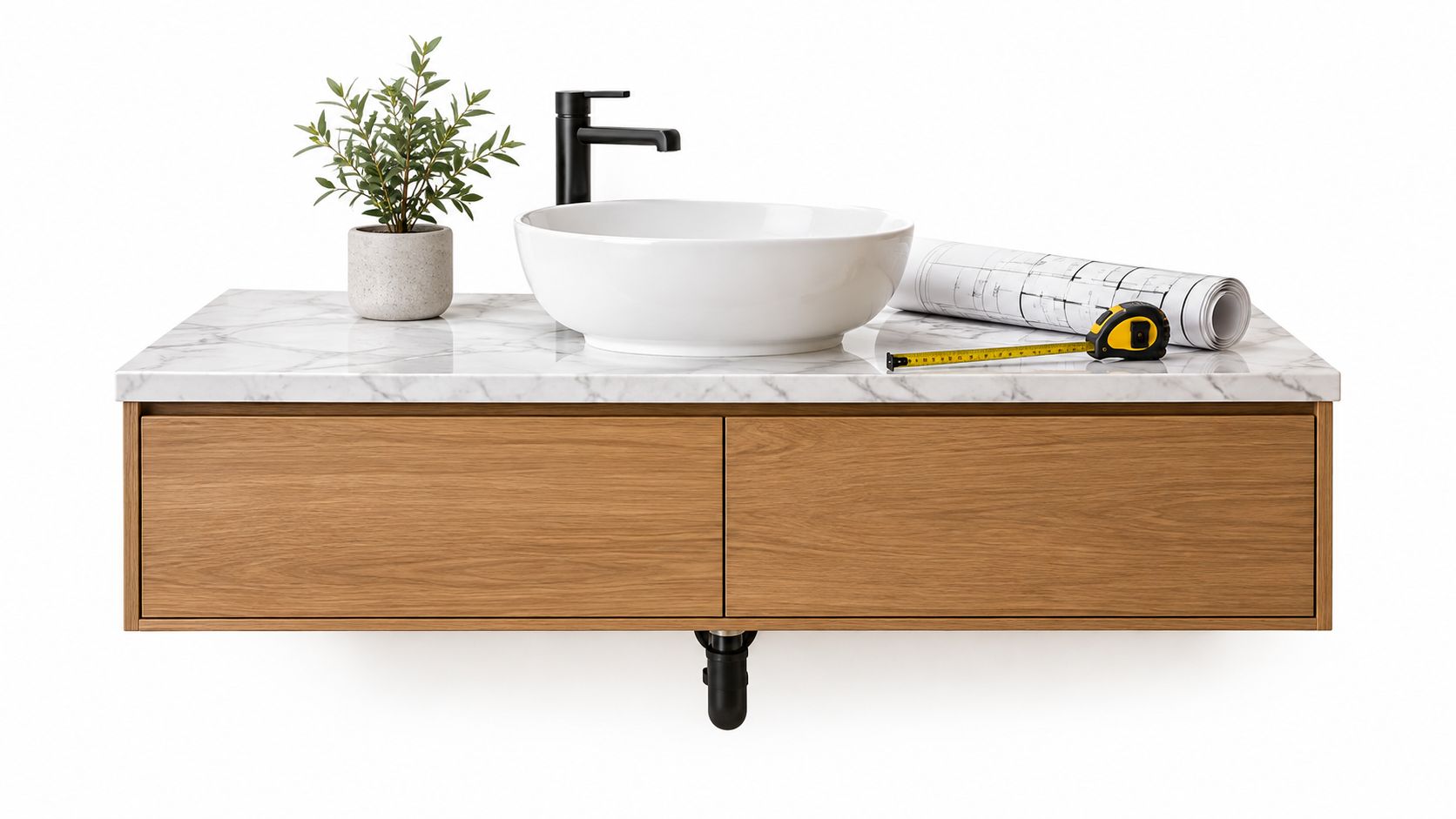
An undermount sink sits below the countertop, so the counter's edge runs directly into the basin without a raised rim. That simple change improves the visual line and makes it easier to push water, toothpaste, and loose debris into the sink. It works especially well with quartz, granite, marble, porcelain, and solid surface, although the sink, slab, cabinet, and support system must be specified as one assembly.
In a modern Cherry Hill bathroom, a white undermount basin below a quiet quartz top can keep the vanity nearly invisible against pale cabinetry. A dark granite counter with a stainless undermount sink takes the room in a more contemporary direction. Solid surface can go further with a fully integrated basin that visually merges the sink and counter.
The mounting details matter
Not every basin is designed for undermount installation. Confirm the sink model before the countertop is templated, then coordinate the cutout, faucet holes, backsplash, and cabinet access. The sink will carry water and daily use, so the installer should use a durable waterproof seal and mechanical support such as approved brackets or reinforcement. Adhesive alone shouldn't be treated as the entire support strategy.
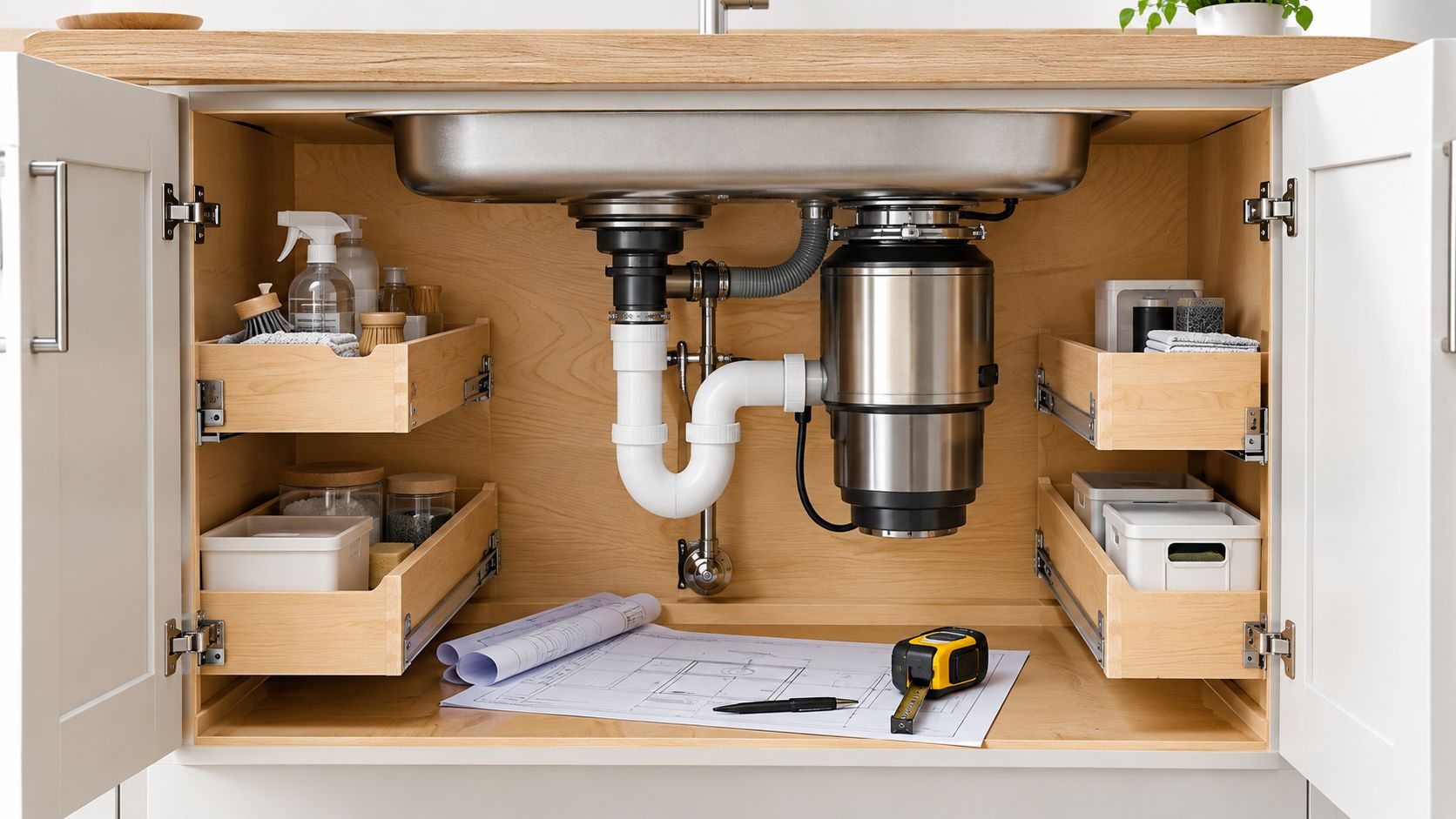
Leave enough room beneath the basin for plumbing repairs and cleaning. A beautiful open vanity can expose unfinished cabinet interiors, supply lines, and the underside of the counter, so specify finished panels or a deliberate interior treatment when those areas are visible.
The cleanest undermount installation starts with a finalized sink specification, not a countertop order.
Check the seal during the early life of the installation, especially if the vanity sees heavy use. Watch for movement, staining, or moisture beneath the rim. Coordinate the faucet finish with cabinet pulls and lighting, but don't let hardware dictate the sink position if that would reduce usable counter space or interfere with drawers.
8. Mixed-Material Countertop Approach
A hybrid vanity can combine the visual impact of natural stone with the practical consistency of an engineered or solid-surface material. Examples include a quartz main counter with a marble accent strip, a granite waterfall side beside a quieter surface, or a porcelain shelf paired with a solid-surface basin. The strongest combinations have a functional reason for every transition.
For a South Jersey bathroom, consider placing the more durable, lower-maintenance material around the primary sink and using natural stone on an adjacent makeup ledge or side return. A warm oak cabinet can connect a pale quartz surface to a wood-look porcelain detail, while brushed brass hardware can repeat the warmth without adding another countertop color. A black granite accent can also ground a light vanity, especially when the same dark tone appears in the faucet, mirror frame, or floor grout.
Draw the transitions before fabrication
Mixed materials can look custom or improvised. The difference usually comes down to planning. Mark the exact transition on the elevation, decide which material receives the sink cutout, and confirm whether the two surfaces have matching thicknesses, finishes, and maintenance requirements. If one material requires sealing and the other doesn't, the homeowner needs a clear care routine that won't damage either surface.
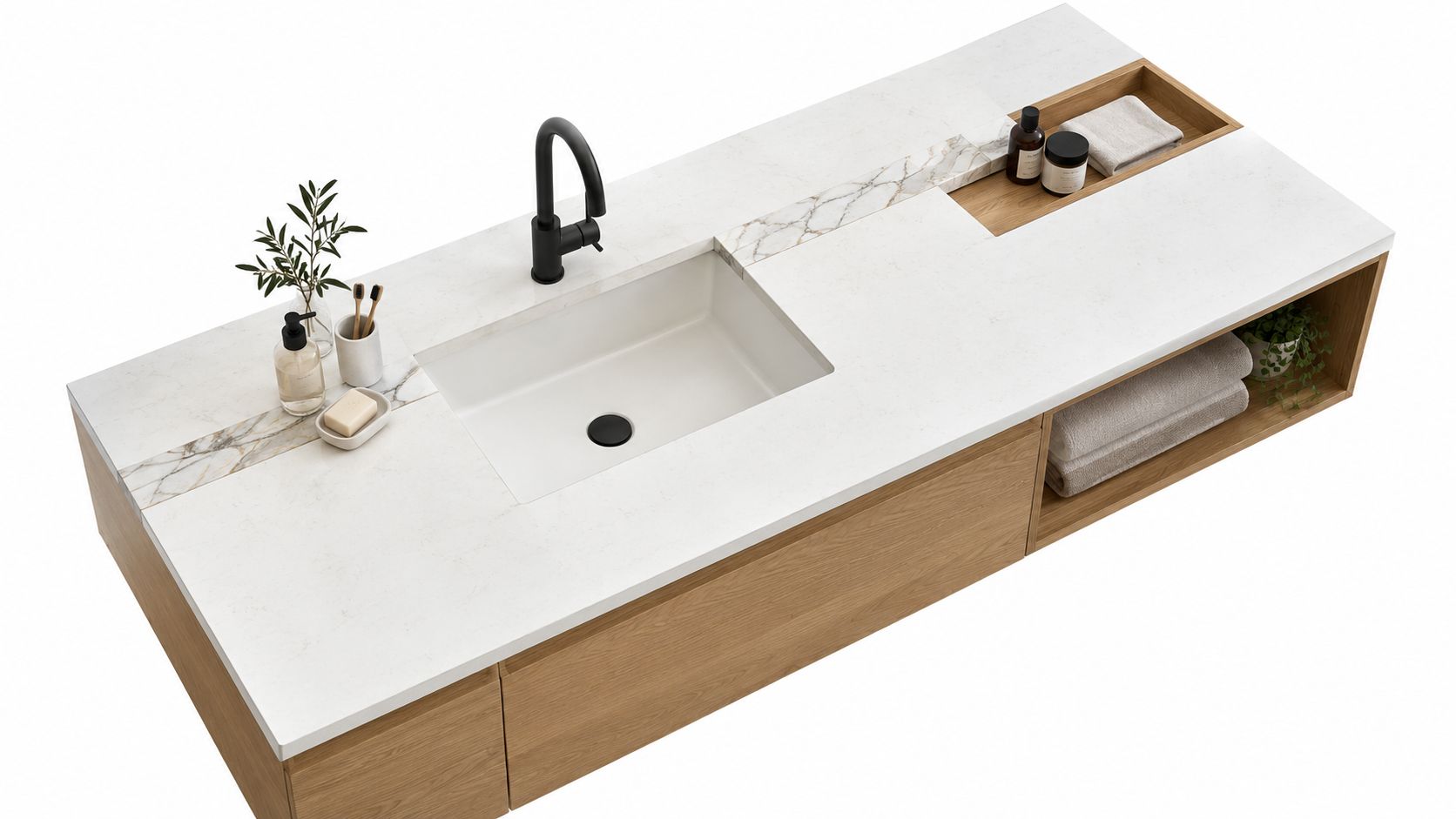
Use a rendering or full-size layout to judge scale. A narrow accent band may look intentional, while an arbitrary seam can make an expensive vanity feel pieced together. Schedule fabrication carefully when suppliers differ, and keep product names, colors, finish details, and warranty information with the renovation records.
One more issue deserves attention when engineered stone is fabricated. A medical review reports that engineered stone commonly contains more than 90% crystalline silica by weight, compared with roughly 40% to 50% in granite and less than 10% in marble. The same review describes dry slab finishing at 215 to 519 micrograms per cubic meter, above the 50-microgram-per-cubic-meter U.S. occupational exposure limit cited there in its discussion of engineered-stone fabrication. This concerns respirable dust during cutting and finishing, not normal use of an intact installed countertop.
Ask the fabricator whether cutting uses wet methods or effective dust extraction, whether workers are trained in silica controls, and how dust is contained and cleaned. Off-site fabrication is different from cutting inside an occupied South Jersey home, and the contractor should explain the difference clearly.
8-Point Bathroom Countertop Comparison
| Item | 🔄 Implementation complexity | ⚡ Resource & cost | 📊 Expected outcomes | ⭐ Key advantages | 💡 Ideal use cases |
|---|---|---|---|---|---|
| Quartz Engineered Stone Countertops | Moderate, professional fabrication, visible seams, heavy support required | $50–$150 / sq ft; resin + quartz, certified installers | Durable, non‑porous, low maintenance, consistent appearance | Exceptional stain/scratch resistance; hygienic; consistent color and long warranties | Busy homeowners, contemporary vanities, high‑traffic bathrooms |
| Marble & Granite Natural Stone Countertops | High, skilled templating, heavy slabs, regular sealing and careful handling | $75–$200+ / sq ft; quarried slabs, sealing supplies, experienced fabricators | Luxurious, unique veining, increases perceived value but requires upkeep | Timeless, one‑of‑a‑kind aesthetics; heat resistance (granite) | Luxury renovations, design‑forward clients, resale‑focused projects |
| Solid Surface (Corian & equivalents) | Moderate, can be heat‑formed, allows seamless sinks, repairable onsite | $40–$120 / sq ft; acrylic/mineral blend, mid‑range fabrication | Seamless integration, non‑porous, repairable, uniform look | Seamless sinks, hygienic, easily repaired and customizable | Families, mid‑budget remodels, projects favoring seamless design |
| Waterfall Edge (installation approach) | High, precise measurement, extra material, complex fabrication and install | +$15–$50 per linear foot beyond countertop; more material and labor | Strong visual focal point; can restrict cabinet options and affect layout | Dramatic, high‑end visual impact; showcases material continuity | Statement vanities, luxury bathrooms, accent installations |
| Porcelain Slab Countertops | High, specialized fabrication, large/slim slabs need expert installers | $100–$200+ / sq ft; imported slabs, specialized tools, limited local availability | Ultra‑dense, heat and stain resistant, minimal maintenance, fewer seams | Superior non‑porosity and heat resistance; thin profiles and large slabs | Ultra‑modern luxury projects, large‑format seamless designs, tech‑forward clients |
| Laminate Countertops (HPL) | Low, easy and fast to install or replace; standard fabrication | $20–$50 / sq ft; lightweight composite layers, widely available | Affordable, wide design variety, shorter lifespan, visible seams possible | Most cost‑effective; quick installation; extensive pattern options | Budget renovations, rental properties, secondary bathrooms |
| Integrated Undermount Sink Installation | High, requires custom fabrication, reinforcement, precise coordination | $500–$1,500 additional install cost; compatible sink and countertop materials needed | Sleek, hygienic sink junction with cleaner lines; needs quality seals | Seamless countertop‑to‑sink transition; easier cleaning; elevated finish | Master baths, design‑conscious homeowners, projects prioritizing hygiene |
| Mixed‑Material Countertop Approach (Hybrid Design) | High, complex design coordination, multiple fabricators, precise seams | $60–$180 / sq ft (varies); multiple materials increase logistics and cost | Custom, high visual interest; balances performance and budget; more seams | Flexible allocation of premium materials; unique, personalized aesthetics | Design‑forward homeowners, bespoke renovations, projects balancing luxury and cost |
Choose the Surface That Fits Your Routine
Start with the budget tier, but don't stop there. Laminate can protect funds for a rental, powder room, or short-term update. Solid surface can offer a clean appearance and integrated sink options without the visual movement of natural stone. Quartz often suits busy households that want a consistent, low-maintenance surface, while granite, quartzite, and marble allow homeowners to prioritize natural variation and a more individualized slab. Porcelain can deliver large-format drama when the fabrication and installation team has the right experience.
Next, identify the maintenance level you can live with. If you don't want to think about sealing, a non-porous engineered or solid-surface material may simplify ownership. If you're comfortable following a care plan, natural stone can reward you with depth and variation. Marble deserves an especially honest conversation because cosmetics, acidic products, and standing moisture can affect its appearance. The best choice isn't the material with the most impressive showroom description. It's the one that matches the bathroom's traffic and your habits.
Then coordinate the pieces that make the vanity feel finished:
- Cabinet color: Pair quiet counters with expressive hardware or tile, and let a strongly veined slab lead when the cabinetry is simpler.
- Backsplash texture: A full-height slab can reduce grout interfaces and create continuity, while smaller tile adds pattern and craftsmanship.
- Faucet finish: Repeat polished nickel, chrome, matte black, or warm brass in at least one nearby detail so the counter doesn't look disconnected.
- Sink configuration: Confirm undermount, integrated, vessel, or offset placement before the slab is templated.
- Edge profile: Use a restrained edge for modern cabinets, or a more shaped profile when the vanity and room architecture support it.
- Ventilation and support: Confirm exhaust performance, cabinet leveling, delivery access, reinforcement, and wall conditions before ordering heavy or large-format material.
South Jersey homes vary widely. A newer bathroom may offer predictable walls and cabinet dimensions, while an older Cherry Hill, Haddonfield, or Camden County property may need leveling, plumbing adjustments, or reinforcement before installation. In Burlington County, the same material decision can look entirely different in a compact guest bath, a family bathroom, or a large primary suite. Compare samples in the room's actual lighting, not only under a showroom's display lights.
The Cabinet Coach provides bathroom remodeling guidance in South Jersey, including coordination among cabinetry, countertops, hardware, and tile. Its mobile showroom model allows homeowners to review selections in the context of the home, and the company offers a complimentary video consultation before discovery and site planning. That kind of coordinated review can help resolve the practical questions, including support, seams, sink placement, ventilation, and maintenance, before a countertop becomes an expensive correction.
The Cabinet Coach brings a mobile showroom to South Jersey homeowners and helps coordinate bathroom cabinetry, countertops, hardware, and tile around your routine and budget. Visit The Cabinet Coach to arrange a complimentary video consultation and start comparing countertop ideas for your bathroom with a guided plan.