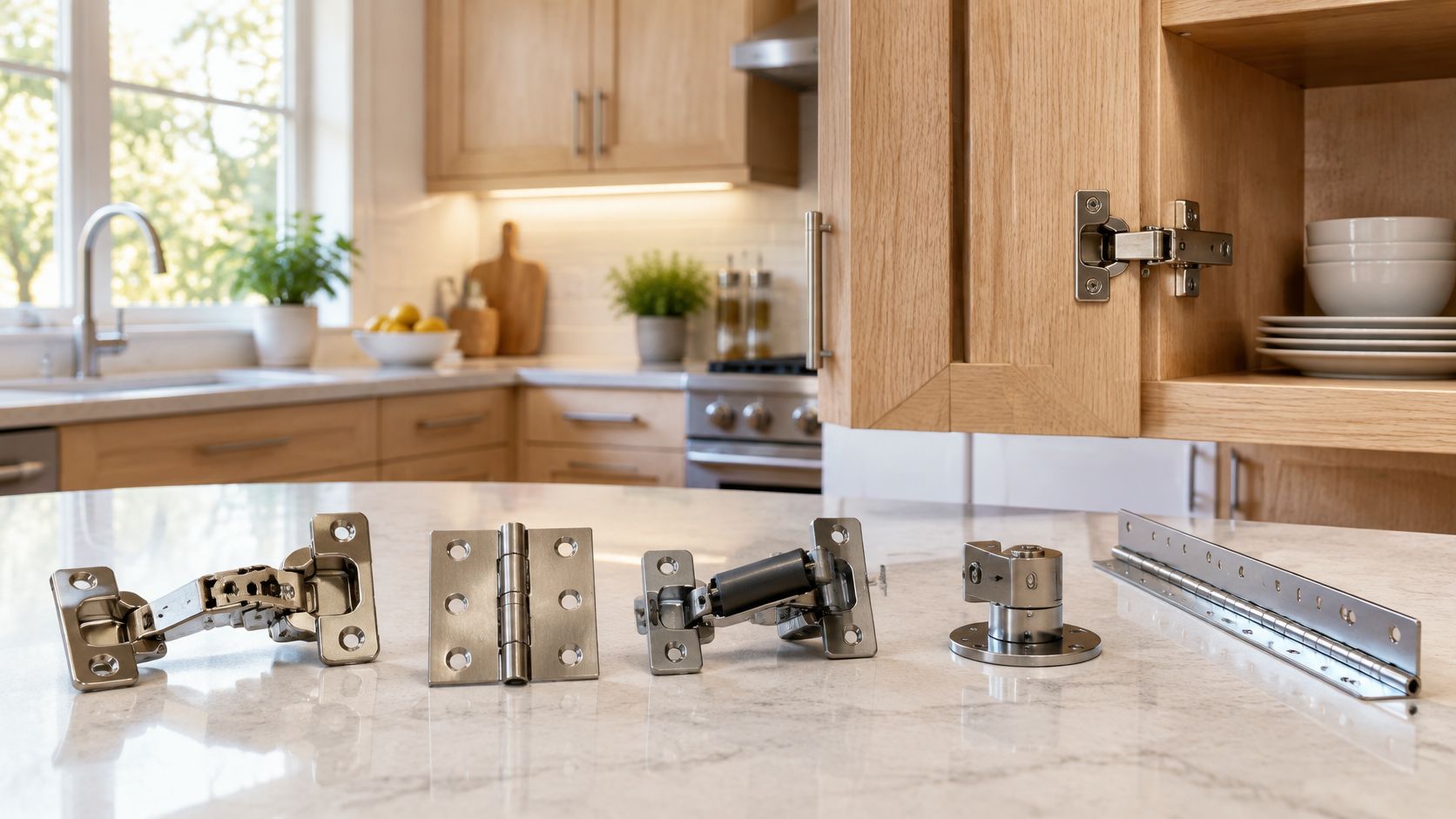
A cabinet door that rubs against its neighbor, slams shut, or hangs crooked can make an otherwise lovely kitchen feel poorly finished. The hinge is easy to overlook while you're choosing cabinet colors and countertops, but it affects how the doors look, how they move, and whether they'll stay aligned through everyday use.
The right choice depends on the cabinet box and the way each door sits over or inside its opening. A hinge that suits a frameless, full-overlay cabinet may not fit an older face-frame kitchen, and a decorative exposed hinge won't give you the same look as concealed hardware. Some options add convenience, while others are mainly about appearance or a specialized opening.
This guide compares eight kitchen cabinet hinge types, with practical trade-offs for South Jersey homes, from newer kitchens in Cherry Hill and Burlington County to traditional face-frame cabinetry in Haddonfield and Collingswood. Cost tiers are qualitative because the price depends on the hinge, cabinet construction, and installation work. If you're also comparing cabinet materials, kitchen cabinet advice from NorCal Construction can help with that part of the renovation.
Table of Contents
- 1. Concealed 35mm European Cup Hinges
- 2. Soft-Close Hinges
- 3. Push-to-Open Hinges
- 4. Overlay Hinges for Full, Half, and Inset Doors
- 5. Cranked Offset Hinges for Face-Frame Cabinets
- 6. Butt Hinges for Exposed, Traditional Detail
- 7. Lift-Up and Bi-Fold Hinges
- 8. Continuous Piano Hinges
- Comparison of 8 Kitchen Cabinet Hinge Types
- Get Hinges Right With South Jersey Experts
1. Concealed 35mm European Cup Hinges
For a clean, modern cabinet front, concealed European cup hinges are a reliable starting point. The round cup fits into the back of the door, and the hinge connects to a mounting plate inside the cabinet. With the door closed, the hardware disappears. The common cup bore is approximately 35 mm, as described in this overview of hinge design.
These hinges are especially well suited to frameless cabinets with full-overlay doors, a common pairing in contemporary kitchens. They can also work on face-frame boxes when the hinge and mounting system are made for that construction. Many models allow installers to fine-tune the door position after hanging, which helps keep neighboring doors and reveals consistent. That adjustability is useful in a long run of cabinets, where a small alignment difference can stand out.
Before ordering, check the cabinet type, door thickness, overlay, cup depth, and opening clearance. A corner cabinet, nearby appliance, or drawer can limit how far a door opens. Use a boring jig or template to keep the cup position consistent across doors. A poorly placed bore is harder to correct than a small adjustment at the hinge.
Installer's rule: Match the hinge to the box and overlay before choosing by finish or price. The wrong mounting geometry can leave a door rubbing or sitting unevenly.
For replacement work, compare the existing cup and mounting layout before buying parts. The Cabinet Coach's guide to cabinet hinge replacement explains what to check. This option is usually a mid-tier choice, with cost affected by whether the doors already have compatible bores and plates. For cupboard layouts that include boiling-water units, consider cabinet airflow for boiling water units as a separate planning detail.
2. Soft-Close Hinges
If a cabinet door bangs shut while someone's cooking or setting the table, a soft-close hinge can make the kitchen feel calmer. A damper slows the door near the end of its closing motion, reducing the impact instead of letting the door slam. Soft-close is commonly offered as a feature on concealed European-style hinges, so homeowners can often combine quiet closing with a clean, hidden appearance.
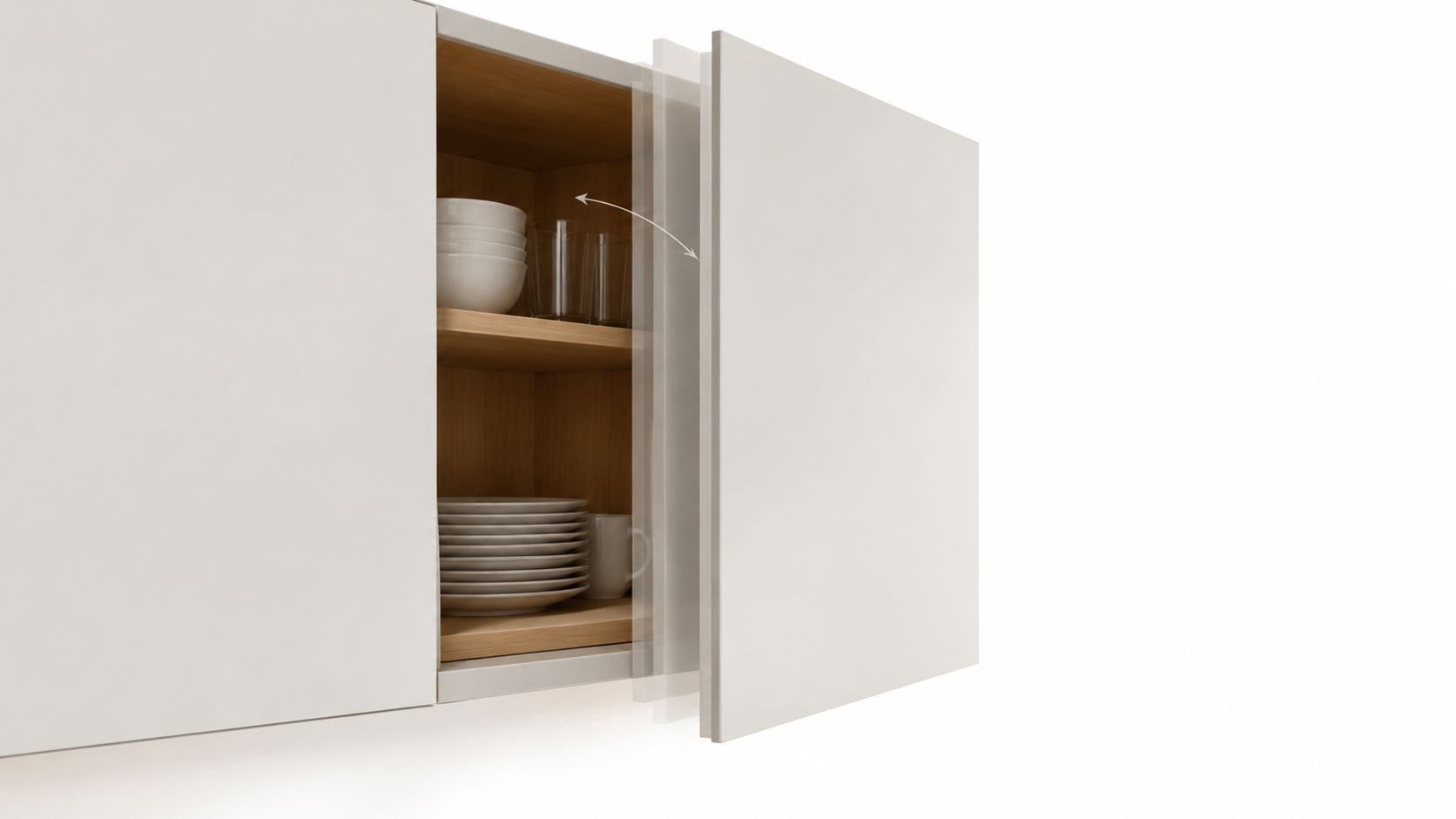
For a Cherry Hill remodel, fitting the same soft-close system throughout the kitchen usually creates a more consistent feel than mixing hinge types. A heavy solid-wood door may need a hinge designed for its weight, and a damper shouldn't interfere with a neighboring door, drawer, or appliance. Ask the installer to test the doors after fitting and adjust the mechanism if the model allows it.
Retrofit or replace
Some existing hinges can be paired with a compatible add-on damper, while others need full hinge replacement. Compatibility depends on the hinge design, overlay, and cup setup, so don't assume a retrofit part will fit just because the current hinge is concealed. The soft-close cabinet hardware guide covers those distinctions.
This is usually a moderate upgrade when existing concealed hinges can be replaced without changing the cabinet doors. It can become a larger job if the replacement requires different mounting plates or new door preparation. Soft-close is a practical everyday feature, but it won't fix a crooked cabinet box or a door that's hung out of alignment. Get the fit right first, then tune the closing action.
3. Push-to-Open Hinges
A handleless cabinet front looks simple because the hardware isn't visible, but the door still needs a dependable way to open. Push-to-open hardware uses a touch latch or release mechanism: press the door, and it pops open enough to grasp. Some systems pair that action with damping, though the exact feel depends on the model.
This style can suit a modern kitchen in a newer South Jersey home, particularly on flat slab doors or an island where handles would interrupt the design. It can also help homeowners who prefer not to grip small knobs. But handleless cabinetry needs accurate fitting. If the cabinet isn't square or the door sits out of position, the latch may release inconsistently or fail to catch.
Practical check: Test the release on every door after installation. A system that feels smooth on one cabinet may need adjustment on another.
Plan the whole run before committing. Mixing push-to-open doors with conventional handles can look intentional when the zones are clearly defined, but inconsistent choices across a single cabinet row can feel accidental. Drawers need their own grip solution, such as a recessed channel, so opening them doesn't become awkward.
This option is generally a higher-cost choice than basic hinges because the latch mechanism adds hardware and fitting considerations. It's not the best pick for every cabinet: frequent handprints can show on touch surfaces, and a door that's misaligned may be frustrating to use. For help coordinating pulls, knobs, and handleless choices, see this guide to choosing cabinet hardware.
4. Overlay Hinges for Full, Half, and Inset Doors
“Overlay” describes the relationship between the door and the cabinet face, not whether the hinge is visible. With full overlay, the door covers nearly the whole cabinet front. With half overlay, doors share a face-frame stile. With inset, the door sits inside the opening, flush with the cabinet face. These distinctions affect door sizing, clearances, and hinge selection, as explained in this guide to cabinet hinge types.
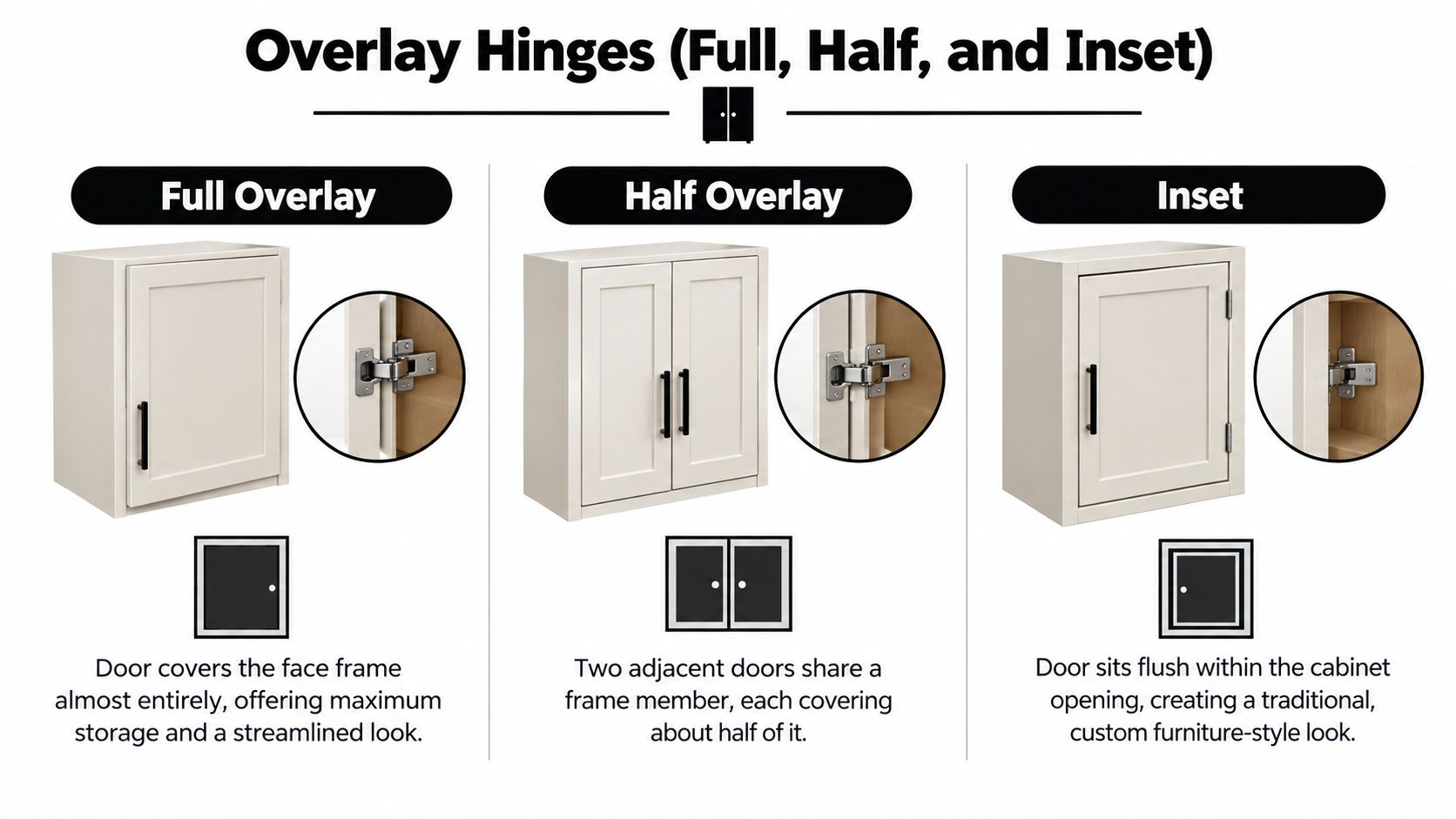
Full overlay is a natural fit for many frameless kitchens, including modern flat-panel or Shaker designs. Half overlay is often found on face-frame cabinets where adjacent doors cover parts of a shared stile. Inset cabinetry can suit older homes in Haddonfield or Collingswood, where a furniture-like appearance fits the architecture, but it leaves less room for installation error.
Decide before replacing doors
Overlay affects the hinge arm and mounting plate, as well as the space needed between adjacent doors. If you're ordering replacement doors for an existing kitchen, first identify whether the cabinets are framed or frameless and measure how the doors sit. Don't assume a hinge that looks similar will preserve the current fit.
Inset doors demand careful alignment and a cabinet opening that's square. A small discrepancy can make the reveal look uneven or cause the door to bind. Full-overlay doors still need correct spacing, especially near corners, appliances, and drawers.
Treat overlay as a fit decision before treating it as a style choice. A consultation can help establish the cabinet type, door dimensions, and suitable mounting system before materials are ordered. For related installation considerations, review this guide to installing cabinet hardware.
5. Cranked Offset Hinges for Face-Frame Cabinets
Older face-frame cabinets have a front frame that changes where the hinge must sit. A cranked, or offset, hinge has a bent arm that helps the door clear that frame as it opens. Many versions are visible when the door is closed, so the hinge finish becomes part of the kitchen's look rather than hardware you try to hide.
This style can work well when a homeowner in Camden County is keeping traditional cabinetry during a renovation. A brushed nickel hinge can complement transitional Shaker doors, while a more decorative finish can suit a classic kitchen. It may also make sense when preserving the existing frame is more practical than converting the cabinet to frameless construction.
The important detail is the relationship between the crank, door thickness, and overlay. A hinge that doesn't match the door position may leave the door proud of the frame, pull it too far inward, or make it bind as it swings. Check clearance with adjacent doors and drawers before installing the full run.
Don't choose by appearance alone. Confirm the hinge's offset matches the cabinet and door, then select a finish that works with the pulls and knobs.
Cranked hinges are often a lower-to-mid cost option, though decorative finishes and specialty configurations can change the price. Soft-close versions may be available, but confirm the model works with the cabinet layout rather than assuming the feature will retrofit. If the goal is to retain a face-frame kitchen while improving its operation, these can be a sensible alternative to replacing the entire cabinet system.
6. Butt Hinges for Exposed, Traditional Detail
A butt hinge has two leaves joined by a central pin. It's a straightforward, visible design that suits heritage details better than an uninterrupted modern cabinet front. Depending on the door and frame, the leaves may be mortised into the wood for a more flush fit or surface-mounted so the hinge remains prominent.
In a historic Haddonfield kitchen, a mortised brass butt hinge can complement inset doors and traditional millwork. The same hinge might look out of place on a sleek frameless island. Butt hinges can also suit pantry doors or a built-in hutch when the owner wants the hardware to read as a deliberate detail.
Fit matters as much as finish. The leaves need to sit correctly against the door and frame, and the pin must allow the door to swing without scraping. On hardwood, pilot holes help reduce the chance of splitting. Check screw length against the frame so fasteners don't break through or weaken a narrow mounting area.
Where this style makes sense
Butt hinges are often a practical, lower-cost choice when replacing like-for-like hardware on traditional cabinetry. They're less attractive when the renovation calls for hidden hardware or frequent fine-tuning, since alignment depends more on accurate placement and the condition of the wood. A visible hinge can also make finish matching important across the cabinet run.
For a built-in china cabinet, a decorative hinge may be exactly the right feature. For a full modern kitchen, concealed hardware will usually create a cleaner face. The Cabinet Coach's overview of kitchen cabinet hardware trends can help homeowners compare visible and concealed finishes.
7. Lift-Up and Bi-Fold Hinges
A standard side-hinged door swings into the room. On an upper cabinet above a counter or near an appliance, that movement can get in the way. Lift-up and bi-fold systems move the door upward, or fold it as it rises, which can keep the opening clear while someone is working at the counter.
For a compact Cherry Hill townhome kitchen, that can be useful where a swinging door would compete with the work area. These mechanisms can also suit upper cabinets above a sink or refrigerator, provided the door has enough clearance to open fully. The system typically combines a hinge with lifting support, so selection depends on the door as well as the cabinet.
Before ordering, check the manufacturer's load guidance and installation template. A door that's too heavy for the mechanism may not stay open; one that's poorly fitted may move unevenly. Also consider who uses the kitchen. A lift-up door may keep the counter clear, but it still needs to be reachable and easy to close for everyone in the household.
This is usually a higher-cost, specialized choice than a basic hinge, and it takes more careful installation. It can be worthwhile where access and clearance matter, but it's unnecessary on an ordinary wall cabinet with room for a conventional door. If your renovation includes folding doors elsewhere, you can also compare bifold door rail systems as a separate project consideration.
8. Continuous Piano Hinges
A continuous, or piano, hinge runs along much of a door's edge instead of connecting it at a few separate points. That makes it useful for long doors, lids, and panels where support along the edge is a priority. In a kitchen, you might see one on an appliance garage, a pantry door, or a storage lid built into an island bench.
For a tall pantry door in an older home, a continuous hinge can be a practical choice if the design allows visible hardware. It also suits an appliance garage where the opening mechanism and door movement need to be coordinated with the counter and nearby appliances. It's less likely to suit a modern cabinet run where the goal is to hide the hinge completely.
Choose a hinge length that supports the door as intended, and check that the pin is seated correctly before tightening everything. Mark and pre-drill the screw locations carefully to keep the hinge from shifting along the edge. Before final tightening, open and close the door to catch binding or misalignment while adjustment is still manageable.
Continuous hinges are often a mid-tier choice, but the installation can take more time than fitting a standard concealed hinge. Material and finish matter in a kitchen environment, particularly where the hinge may see moisture or frequent handling. If the door is heavy or unusually configured, confirm the hinge is suitable for that application rather than relying on its appearance alone.
Comparison of 8 Kitchen Cabinet Hinge Types
| Hinge type | 🔄 Installation complexity & requirements | ⚡ Efficiency & adjustability | 📊 Expected outcome & key advantages | 💡 Ideal use cases |
|---|---|---|---|---|
| Concealed 35mm European cup | Moderate; requires accurate 35mm cup boring and a mounting plate | ⭐ Three-way adjustment; soft-close or push-to-open options available | Clean, hidden hardware and precise door alignment | Modern frameless kitchens; compatible face-frame or inset cabinets |
| Soft-close (integrated damper) | Low to moderate; confirm door weight and align hinge or damper | ⚡ Quiet, controlled closing; damping force may be adjustable | ⭐ Reduces slamming, noise, and impact wear | Busy kitchens, family homes, vanities, and resale upgrades |
| Push-to-open (touch-latch) | Moderate; precise alignment and weight-rated latch required | ⚡ Opens with a push; release force may be adjustable | Handle-free appearance; convenient where gripping a handle is difficult | Contemporary handleless kitchens, flat-panel doors, and accessible designs |
| Overlay hinges (full, half, inset) | Varies; requires early planning of door size, overlay, and reveal | 🔄 Adjustability depends on hinge style; inset fitting needs tighter tolerances | ⭐ Controls cabinet appearance and door coverage | Full overlay for streamlined cabinets; half overlay for shared stiles; inset for furniture-style cabinetry |
| Cranked (offset) hinges | Low to moderate; screw-mounted, with crank and overlay needing a match | 🔄 Limited adjustment; basic tools typically sufficient | Visible decorative hardware; clears the face frame | Traditional or transitional face-frame cabinets |
| Butt hinges (exposed or decorative) | Moderate; surface mounting is simpler, while mortising requires precision | 🔄 Limited adjustment; removable versions ease door removal | ⭐ Strong, simple, replaceable hinge with a traditional look | Heritage cabinets, pantries, hutches, and inset doors |
| Lift-up and bi-fold hinges | High; requires precise measurements, templates, and load-rated hardware | ⚡ Holds upper doors open and reduces swing conflicts | ⭐ Improves access and saves clearance around cabinets | Upper cabinets, compact kitchens, and cabinets above counters or appliances |
| Continuous (piano) hinges | Moderate; requires full-length alignment and multiple fasteners | 🔄 Distributes load evenly; little adjustment after installation | ⭐ Supports long or heavy doors and helps reduce sagging | Tall pantry doors, appliance garages, and storage lids |
Get Hinges Right With South Jersey Experts
Start with the cabinet, not the hinge display. Identify whether the box is face-frame or frameless, then establish whether each door is inset, half overlay, or full overlay. Those details determine which hinge geometry can fit and whether existing doors can be reused without additional drilling or mounting changes.
After that, decide what matters most in daily use. Concealed adjustable hinges suit many modern kitchens, while exposed butt or cranked hinges can preserve the character of traditional cabinetry. Soft-close adds a quieter finish to busy rooms, and lift-up or continuous systems solve specific clearance or support needs. There isn't one best hinge for every South Jersey home; the right choice depends on construction, door fit, appearance, and how the kitchen is used.
Cost depends on those same details. Replacing a compatible hinge is different from changing the door style or converting the cabinet construction. A hinge that appears inexpensive can require extra work if its mounting pattern doesn't match, while a feature upgrade may be worthwhile if it improves daily use. Ask for a clear estimate that separates hardware selection from any cabinet or door preparation.
The Cabinet Coach brings a mobile cabinet showroom to homeowners in and around Cherry Hill, with guidance on cabinet design and coordinated selections for cabinetry, countertops, hardware, and tile. An in-home consultation can help you inspect the cabinet box, compare finishes, check the door overlay, and discuss whether replacement or a broader remodel makes more sense. That's particularly helpful when an older face-frame kitchen has been altered over time, or when new doors need to work with existing boxes.
For homes across Camden and Burlington counties, bring photos of the open cabinet, the closed door, and the existing hinge if you have them. Note any doors that rub, sag, or collide with nearby drawers and appliances. Those practical details help narrow the options before you order. For hinge selection, the most useful result is a coordinated plan that fits the cabinet you have, suits the kitchen you want, and avoids preventable installation problems.
The Cabinet Coach brings cabinet, hardware, countertop, and tile selections to South Jersey homeowners, with design guidance for kitchen and bathroom remodeling. Book a consultation through The Cabinet Coach to review your cabinet construction, compare hinge options, and plan a renovation that fits your home.