You're standing in a South Jersey showroom, comparing slabs that all promise to transform your kitchen. One marble sample catches your eye immediately. Its soft background and sweeping veins make the cabinets look more expensive, the room feel brighter, and the island look like it belongs in a design magazine. Then the practical questions arrive. Will coffee stain it? Will lemon juice damage it? Can a busy family live with it?
That's the core question behind marble kitchen countertops pros and cons. Marble is beautiful, functional, and capable of lasting for generations, but it isn't a maintenance-free surface. The right choice depends less on whether marble is “good” and more on whether its changing appearance fits your routines, expectations, and budget.
If you're still shaping the overall design, review these countertop and backsplash ideas alongside your cabinet layout. You can also look at how marble works in adjoining spaces through Suburban Furniture's marble dining furniture for a broader sense of how natural stone contributes to a room.
Table of Contents
- The Timeless Dream of a Marble Kitchen
- The Unmistakable Pros The Allure of Marble
- The Practical Cons: Living with Marble
- Marble vs Granite and Quartz A Head-to-Head Comparison
- Understanding the Long-Term Cost and Maintenance
- Making the Final Decision Is Marble Right for Your Home
The Timeless Dream of a Marble Kitchen
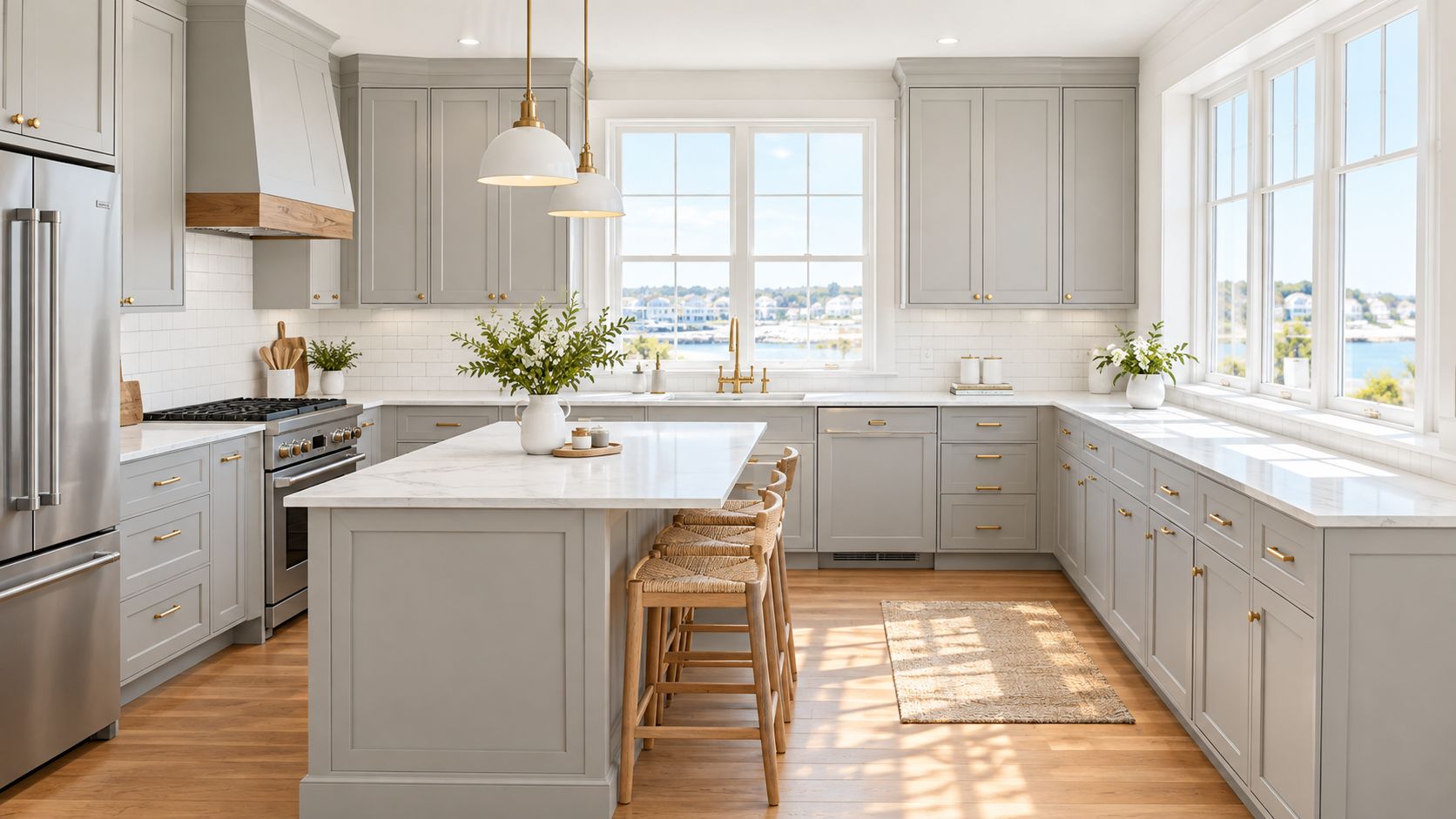
A homeowner usually chooses marble with their eyes first. They see a pale island with gray veining, brushed brass hardware, painted cabinetry, and daylight moving across a polished surface. The kitchen feels established rather than trendy. It has the visual quiet that makes a room feel finished.
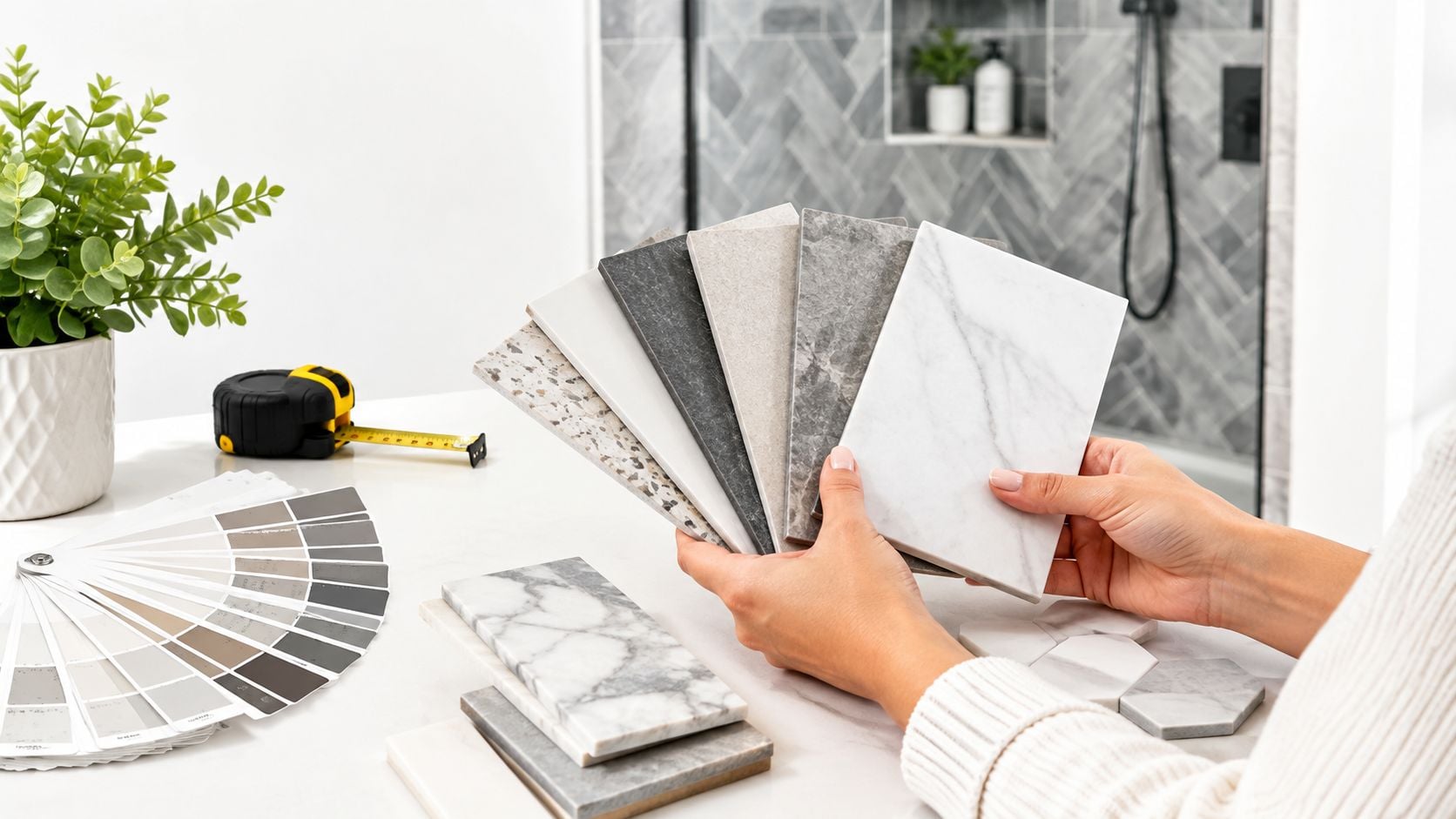
That reaction is valid. Marble has a depth and variation that manufactured surfaces struggle to reproduce. Each slab has its own movement, background tone, and vein pattern. Even two pieces from the same stone family can create noticeably different kitchens.
The hesitation comes later, often after someone hears that marble can scratch, stain, or show dull marks. Those concerns aren't exaggerated. Marble asks you to use cutting boards, wipe spills promptly, protect the surface from harsh cleaners, and schedule resealing. It also asks you to accept that the counter may look different after years of cooking than it did on installation day.
The central decision: Do you want a countertop that stays visually consistent, or one that develops character as your household uses it?
That distinction matters in a Cherry Hill or Medford kitchen just as much as it does in a high-end design magazine. A low-traffic baking area has different demands from a kitchen where children prepare snacks, guests gather around the island, and dinner gets cooked in a hurry.
Marble isn't automatically impractical. It's just less forgiving than harder, more uniform alternatives. Some homeowners see a small etch near the sink as damage. Others see it as part of the material's story. Neither response is wrong, but choosing marble without knowing which person you are will lead to frustration.
The best design advice is direct: choose marble because you appreciate its behavior, not because you expect to prevent that behavior forever.
The Unmistakable Pros The Allure of Marble
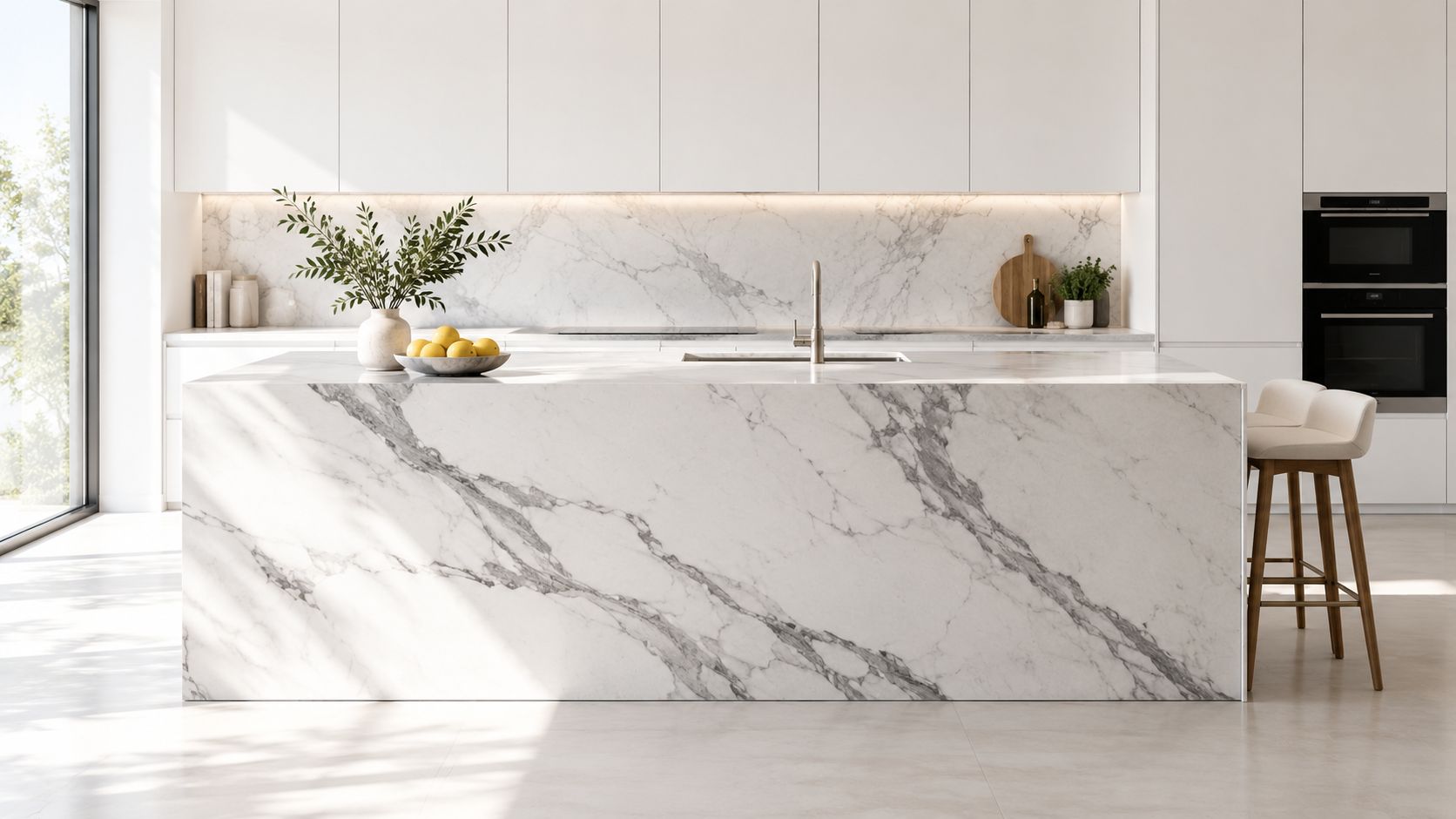
Marble earns its reputation through appearance. Its surface has a soft visual quality that reflects light without looking artificial, while natural veining gives a kitchen structure and movement. White and light-gray varieties can make cabinetry feel cleaner and help a compact kitchen appear more open.
Beauty that doesn't look copied
The strongest argument for marble is its individuality. Quartz can create a convincing marble-inspired look, but engineered consistency is also its limitation. Marble has natural variation, including subtle shifts in tone, cloudy areas, and veins that may change direction across the slab.
That variation affects design decisions. A fabricator can help position the most dramatic movement on an island or use a quieter portion near the perimeter. Slab selection becomes part of the design rather than a final product choice made after the cabinets are ordered.
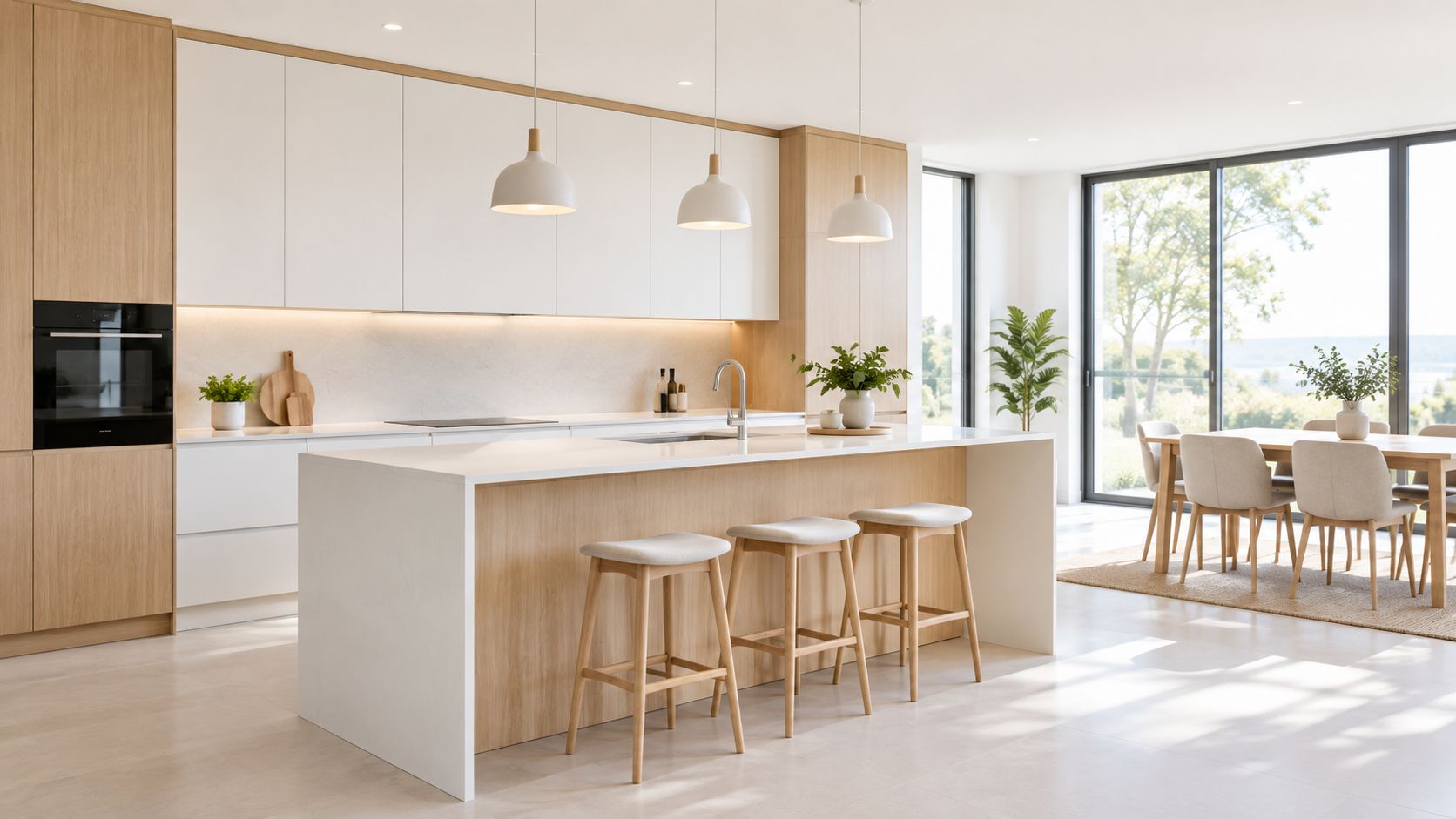
Marble also brings a tactile quality that works well with painted wood cabinetry, natural oak, unlacquered brass, and traditional South Jersey home styles. It can support a classic renovation without making the kitchen feel dated, and it can soften a contemporary room filled with flat panels and metal accents.
A useful surface for bakers
Marble's naturally cool surface is a practical advantage for people who roll pastry, shape dough, or work with chilled ingredients. The smooth stone gives bakers a dedicated work area that feels purposeful rather than decorative.
That benefit is most valuable when the layout supports it. A marble island with generous landing space can become the baking center of the kitchen, while a small marble insert may provide the same function without committing every work surface to the material.
Designer's advice: If baking is your priority, plan the marble around the workflow. Put it where mixing, rolling, and transferring food actually happen.
Marble also handles everyday kitchen warmth well, although protective habits still make sense. Trivets and heat-safe landing zones protect the finish and reduce the chance that a hurried cooking moment leaves a mark.
Luxury without the highest material tier
Marble combines a premium appearance with relatively accessible installed pricing. Consumer pricing guidance lists marble at $50 to $150 per square foot installed, which helps explain why it appeals to homeowners seeking a luxury look without automatically choosing a higher-priced quartzite.
Price still varies by slab, fabrication, edge detail, installation complexity, and the amount of stone required. Treat the material range as an early planning reference, not a finished project quote. For a broader overview of materials and design considerations, explore different countertop types.
Marble makes sense when the visual return matters more than uniformity. It gives a kitchen a focal point, supports both traditional and modern cabinetry, and rewards homeowners who enjoy natural materials with visible variation.
The Practical Cons: Living with Marble
Marble's appeal comes with responsibilities. It is porous, relatively soft, and calcite-based, so spills, impact, abrasion, and acidic ingredients can leave visible evidence of daily use. For a South Jersey kitchen, the right question is whether your household will accept that care routine and the changes that come with time.
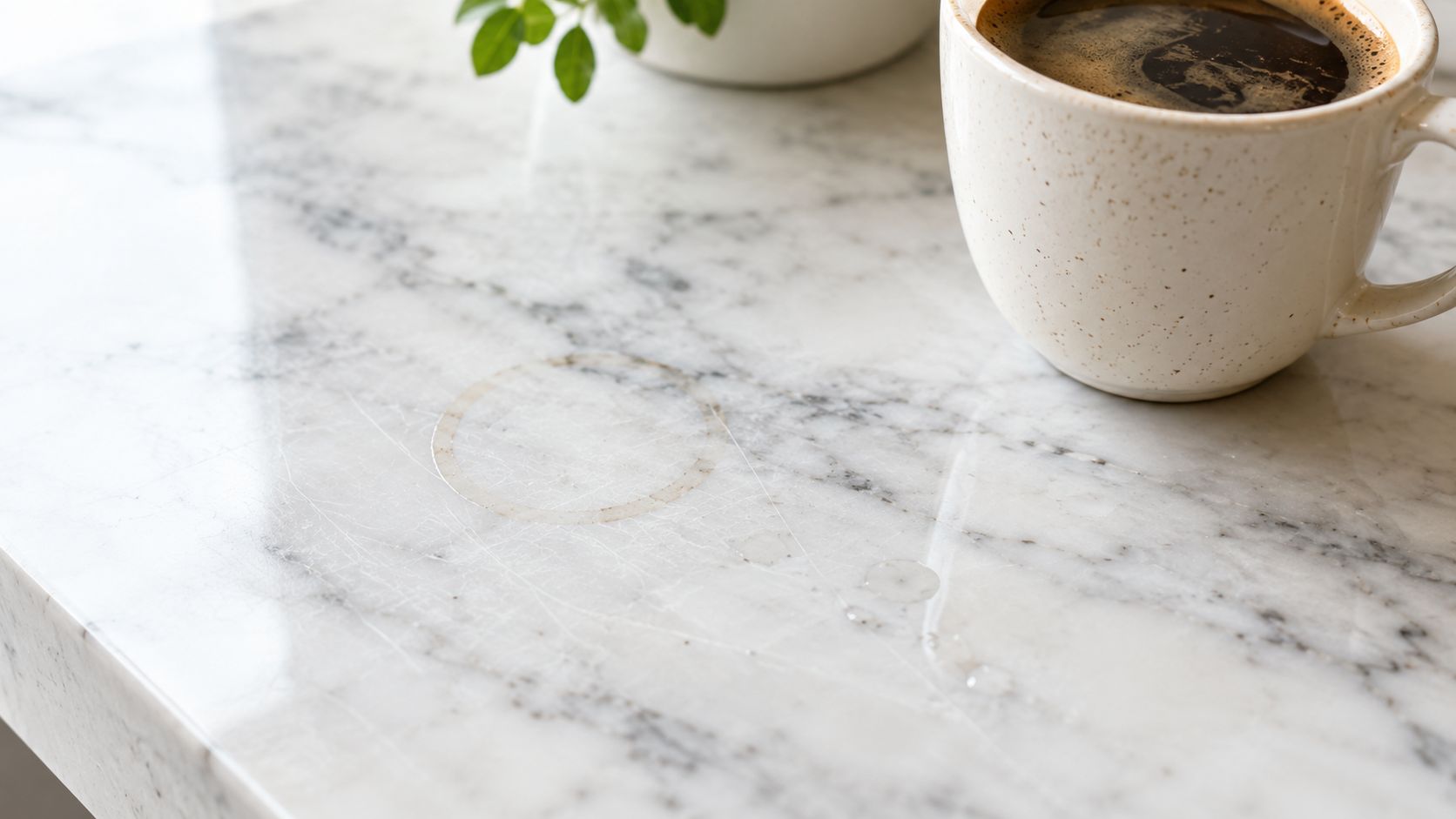
Staining and etching are different problems
A stain is discoloration caused by a substance entering the stone. Coffee, wine, oil, and colored sauces can create one if they remain on the surface. Sealing reduces absorption and makes many spills easier to remove, but it does not make marble impermeable.
Etching is chemical damage, not a colored stain. Lemon juice may leave no brown or red residue while still creating a dull patch by reacting with marble's calcite. Vinegar, wine, tomato sauce, lemon juice, and some cleaners can cause similar marks. Stone-care guidance explains that marble's calcite composition makes it reactive to kitchen acids, while sealing doesn't stop etching.
That difference determines how you clean. You must protect marble from absorption and chemical reactions. Use a neutral stone cleaner and a soft cloth, then wipe spills promptly. Vinegar-based sprays and abrasive powders have no place on the surface.
Scratches and chips are part of the risk
Marble typically measures 3 to 4 on the Mohs hardness scale, compared with granite at about 6 to 7 and quartzite at about 7 or higher, according to this marble stain and hardness guide. Marble therefore faces greater risk of scratches, edge wear, and chips in a busy kitchen.
Use a cutting board, lift heavy cookware instead of dragging it, and skip scouring pads that can roughen the finish. Marble works well as a countertop, but it should not serve as a cutting board or workbench.
Pay close attention to the edges. A sharply detailed profile may look refined while remaining more exposed to impact beside a dishwasher, range, or main walkway. Choose an edge profile suited to the room, and use professional fabrication to reduce the visible effects of ordinary knocks.
Patina requires a change in expectations
An untouched marble slab looks finished and formal. A used marble countertop records the kitchen around it through small scratches, gentle dulling, edge wear, and marks near the sink.
That evolution is known as patina. Recent design commentary describes growing interest in a lived-in appearance rather than permanent perfection. Discussion of marble's natural aging and patina supports judging marble by how it ages, not only by its appearance on installation day.
Your tolerance for patina should guide the decision. If a mark will distract you every time you pass the island, choose another material for the main work surface. If you appreciate natural materials that become more personal through use, those marks can add character instead of frustration. Marble suits households that clean promptly, use boards and trivets, and accept gradual change. It is a poor match for anyone who expects a permanently uniform finish with little attention.
Marble vs Granite and Quartz A Head-to-Head Comparison
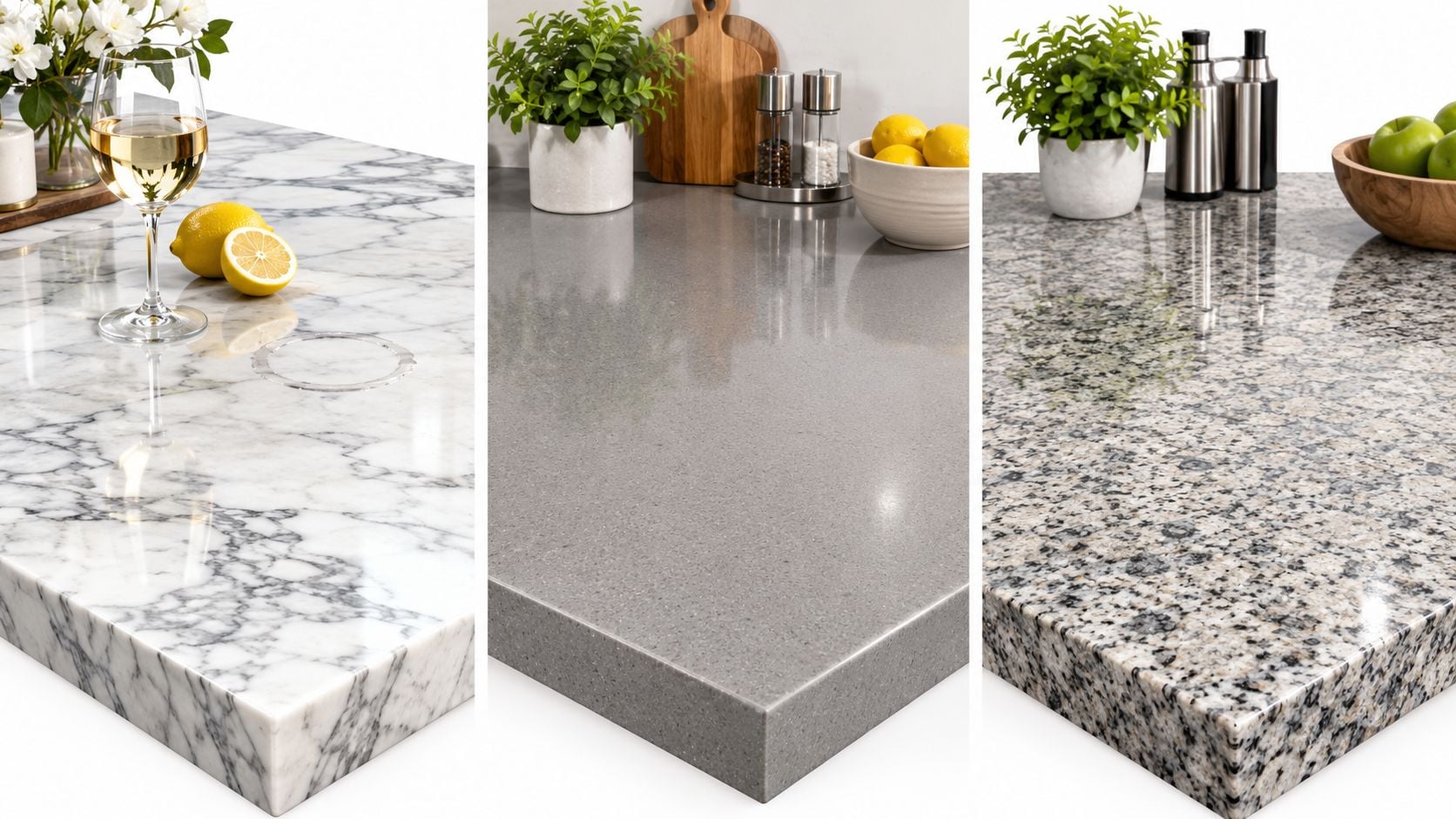
The right comparison isn't merely “beautiful versus practical.” Marble, granite, and quartz create different ownership experiences. Marble offers natural variation and a cool working surface, granite brings greater hardness, and quartz offers a consistent engineered finish with less routine care.
| Attribute | Marble | Granite | Quartz |
|---|---|---|---|
| Durability | Softer and more vulnerable to scratches, chips, and edge wear | Harder natural stone with stronger scratch resistance | Engineered surface designed for consistent everyday performance |
| Stain resistance | Sealing helps, but spills still require prompt attention | Varies by stone and sealing condition | Generally chosen for a more forgiving, low-care surface |
| Maintenance | Periodic resealing and careful cleaning | Sealing and routine stone care may be required | Usually minimal routine maintenance |
| Heat resistance | Handles everyday warmth, but trivets remain wise | Strong heat tolerance, with care still recommended | Protect from direct extreme heat |
| Cost | Often listed at $50 to $150 per square foot installed, depending on selection and installation | Varies by slab and fabrication | Varies by design, brand, and installation |
| Uniqueness | Every natural slab has distinct veining and movement | Each slab is unique, often with more granular or dramatic patterning | More consistent, including engineered marble-look designs |
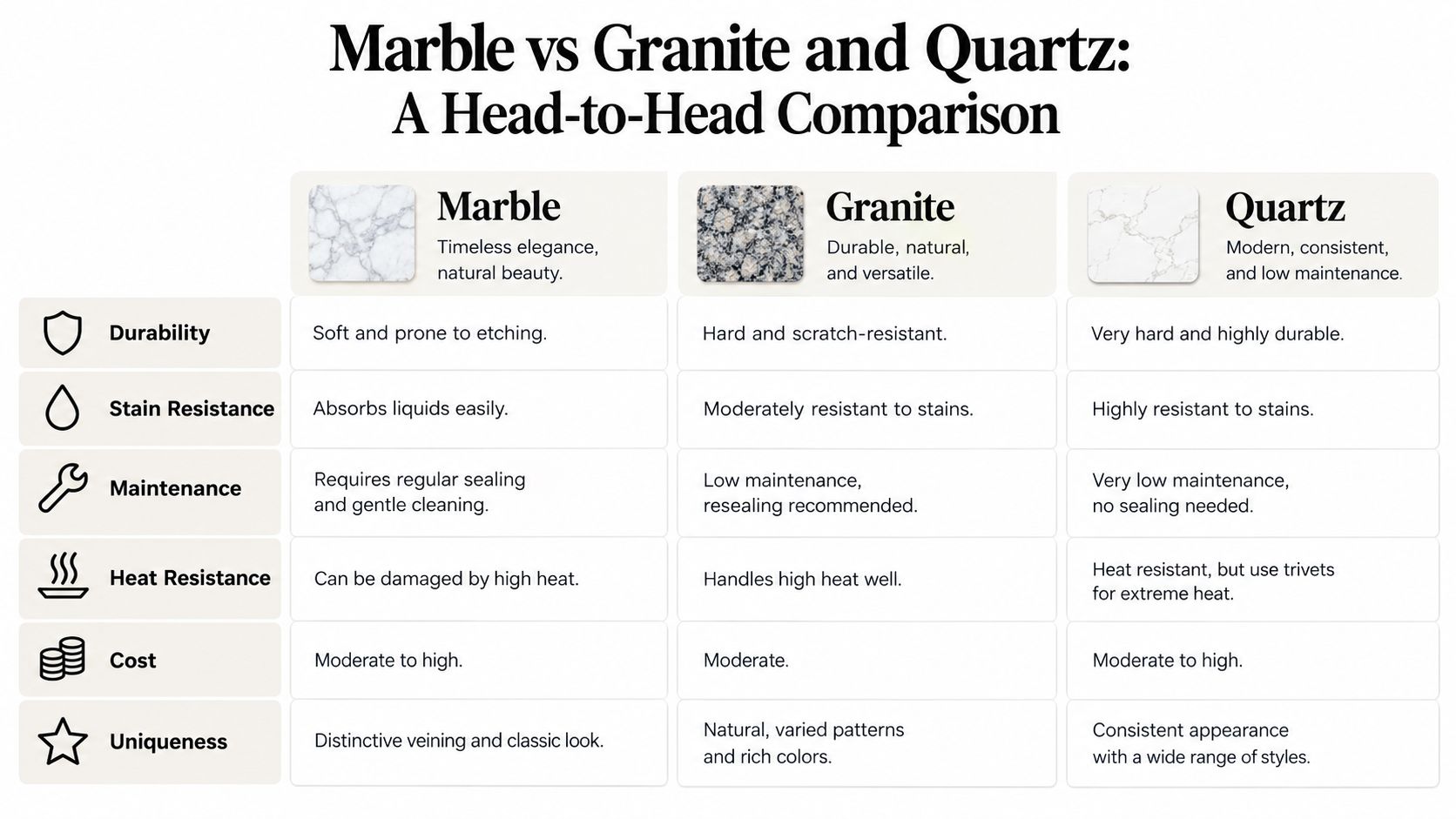
Marble against granite
Granite is the more forgiving natural stone for a busy kitchen. Its greater hardness makes it less likely to show knife marks and everyday abrasion, and its patterning often disguises minor activity better than a pale marble surface.
Granite's appearance depends heavily on the slab. Some varieties have quiet movement and work well in a calm kitchen. Others have speckling, strong contrast, or multiple colors that become the dominant design feature. Marble usually delivers a softer, more architectural look, especially in white and gray kitchens.
Choose granite when you want natural stone but don't want every spill or utensil to feel like a potential event. Choose marble when the specific veining is central to the room and you're willing to protect the surface.
Marble against quartz
Quartz is the straightforward choice for homeowners who want a clean look with minimal intervention. Its engineered composition supports consistent color and pattern, and many designs imitate marble without requiring the same level of vigilance.
The trade-off is visual repetition. High-quality quartz can look refined, but it won't offer the exact geological variation of a natural slab. For some homeowners, that consistency is a benefit. For others, it makes the kitchen feel less connected to natural materials.
A two-material plan can solve the conflict. Use marble on a baking zone or island where its beauty and cool surface provide real value, then select a more forgiving material for a heavily used perimeter. Before choosing, compare how each option fits your layout through this countertop material comparison.
Homeowners researching options in different markets can also use guides such as this quartz and granite comparison from Interiors by DeX to understand how material priorities change by project. The same principle applies in South Jersey. Start with your habits, then evaluate the slab.
Understanding the Long-Term Cost and Maintenance
The purchase price is only one part of marble ownership. The larger commitment is behavioral. You'll need to clean spills quickly, use suitable products, protect the surface during cooking, and maintain the seal.
Consumer-facing guidance commonly recommends resealing a kitchen marble countertop every 6 to 12 months, depending on use. Consumer Reports' countertop buying guidance also makes clear that sealing improves stain protection but doesn't eliminate every risk. Even sealed samples can show permanent marks from certain substances, including hard-water remover.
The recurring care routine
A workable marble routine is simple, but it has to become automatic:
- Clean spills promptly: Pay special attention to coffee, wine, oils, tomato-based foods, and citrus.
- Use a neutral cleaner: Avoid acidic sprays, vinegar solutions, bleach-heavy products, and abrasive powders unless a stone-care professional specifically recommends them.
- Protect the work surface: Keep cutting boards, trivets, and coasters available where people use the island.
- Inspect the seal: Notice whether water stops beading or begins darkening the stone, then ask a qualified stone professional about resealing.
- Accept minor changes: Don't polish every small mark immediately. Some surface variation is part of the material's appeal.
The hidden cost is attention. A family that cooks quickly and leaves dishes overnight may find marble demanding. A careful cook who already uses boards, trivets, and a daily wipe-down may barely notice the routine.
Budget for more than the slab
Your project budget should account for slab selection, templating, fabrication, transportation, installation, edge work, sink cutouts, and maintenance. A complex island with bookmatched movement or difficult access may require more planning than a simple perimeter run.
Don't compare a marble material price with an alternative's material price alone. Compare the complete installed design and the care expectations that follow. A broader renovation budget guide, such as this overview of a typical Dublin kitchen renovation budget, can help illustrate why materials should be evaluated within the whole project rather than in isolation.
You can also review countertop cost per square foot as an early planning step. For a South Jersey remodel, your designer or fabricator should confirm current local pricing because slab availability, installation access, and project details influence the final number.
Marble isn't expensive only because of what you buy. It can also cost you convenience. If the surface requires habits your household won't maintain, the cheapest-looking quote may become the least satisfying choice.
Making the Final Decision Is Marble Right for Your Home
Marble is right for your kitchen when you value natural beauty, tactile quality, and evolving character more than a permanently uniform finish. It's especially compelling for homeowners who bake, entertain selectively, or want one expressive focal surface rather than an indestructible work zone everywhere.
The strongest marble candidates usually share a few habits. They use cutting boards, keep a cloth nearby, understand that acidic ingredients can etch the surface, and won't panic when the stone gains a little history. They may prefer a honed finish because its softer appearance can make daily marks less visually dominant.
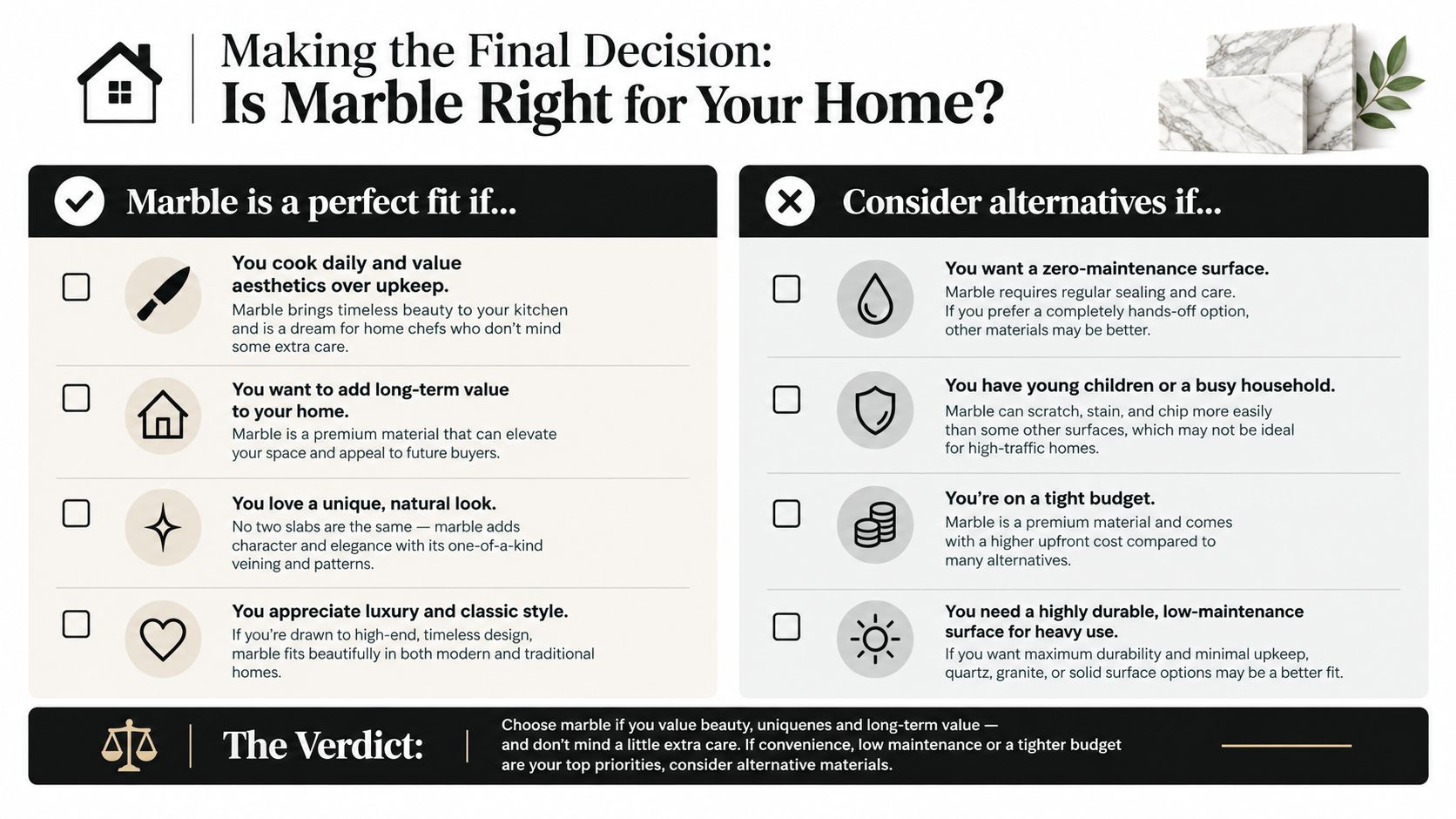
Marble is a strong fit if
- You want a one-of-a-kind focal point: The island, baking station, or short run can showcase the slab without forcing every surface to carry the same care burden.
- You bake regularly: A cool, smooth work area adds genuine function to the visual appeal.
- You appreciate patina: Small etches, scratches, and edge changes won't automatically feel like failures.
- You're willing to maintain the stone: Periodic resealing and prompt cleanup are manageable parts of your household routine.
Consider another surface if
- You want zero daily vigilance: Marble requires more awareness than a low-maintenance engineered option.
- Your kitchen sees hard use: Frequent dragging, chopping, spills, and heavy cookware increase visible wear.
- You need a pristine resale presentation: A consistent, uniform surface may communicate your priorities more clearly to a broad range of buyers.
- You dislike natural variation: Veining, color shifts, and aging are inherent rather than defects to be corrected.
A mixed-material kitchen deserves serious consideration. Marble can occupy the place where its qualities matter most, while granite or quartz handles areas exposed to more abuse. That approach gives you a design statement without asking one material to satisfy every requirement.
Use this guide to choosing kitchen countertops to compare your cooking habits, cleaning tolerance, desired appearance, and project budget before approving a slab. For a South Jersey renovation, also consider traffic patterns, children's routines, entertaining style, and whether the kitchen must serve as a work zone throughout the day.
My recommendation is simple. Choose marble if you're buying character, not perfection. If you want the look but not the maintenance, choose quartz or place marble in a limited-use feature area. The best countertop is the one that still feels right after the novelty of installation has passed.
The Cabinet Coach helps South Jersey homeowners evaluate cabinetry, countertops, hardware, and tile through a personalized mobile showroom and guided remodeling process. If you're deciding whether marble fits your kitchen habits, visit The Cabinet Coach to schedule a complimentary video consultation and discuss a practical design direction.