
Construction management focuses on physical site execution and trade coordination, while project management spans the full lifecycle from design through closeout. For a residential remodel, the most reliable approach often combines both, so one person protects the design and procurement plan while another controls daily jobsite decisions.
You may be asking this after a designer, cabinet supplier, plumber, electrician, and general contractor each gave you a slightly different answer about who runs your kitchen or bathroom renovation. In a South Jersey home, a cabinet dimension can affect plumbing rough-ins, countertop templating, appliance placement, tile transitions, and the installation sequence. If nobody owns those handoffs, the homeowner usually becomes the unpaid coordinator.
A construction manager can keep trades moving and resolve field problems quickly. A project manager can connect selections, budget decisions, contracts, schedule milestones, and final handoff. The question isn't which title sounds more senior. It's who has accountability for the complete decision flow from design through ordering and installation.
Table of Contents
- Understanding the Core Distinction
- Side-by-Side Role Comparison
- How Each Role Handles Residential Remodel Challenges
- Real-World Scenarios for South Jersey Homeowners
- The Hybrid Workflow Emerging in 2026 Remodels
- How The Cabinet Coach Coordinates With Both Roles
- Making the Right Choice for Your Renovation
Understanding the Core Distinction
A homeowner in Cherry Hill hires a designer for a kitchen layout and a contractor for the build. The cabinet order is still being revised when the plumber arrives to frame rough locations. The contractor follows the information available on site, while the designer assumes the final cabinet plan will reach the trades later. When the cabinet specifications change, the plumbing needs to move, and the homeowner faces a preventable coordination problem.
That scenario illustrates the practical difference in construction management vs project management. Construction management is a narrower, execution-heavy discipline centered on the physical build. It includes site coordination, subcontractor supervision, safety enforcement, quality control, and material availability during construction, as described by Deltek's comparison of construction management and project management.
Project management has a wider lens. It begins with initiation and planning, then continues through design, procurement, contracts, stakeholder communication, budget governance, construction, and post-construction handoff. A project manager should know whether a design decision has been approved, whether the related product has been ordered, and whether the installation date still works with the trade schedule.
Why titles create confusion
A remodeler may call one person a project manager even when that person spends most of the day supervising installers. Another firm may use construction manager for someone who also handles design coordination and homeowner communication. The title tells you less than the written scope of responsibility.
Practical rule: Ask who owns a decision after the design meeting ends. If the answer is “the homeowner needs to tell the contractor,” the process has a coordination gap.
For homeowners comparing construction management services, the useful test is simple. Can the assigned team connect the cabinet plan to field conditions, procurement dates, trade sequencing, quality checks, and final completion? If yes, the model may work regardless of the label. If not, adding a second title won't fix the handoff.
Side-by-Side Role Comparison
The two roles optimize different control loops. A construction manager is closest to the work and makes practical decisions about sequencing, access, materials, safety, and quality. A project manager protects the broader delivery system, including the relationship between scope, budget, schedule, design approvals, procurement, and closeout.
Construction managers typically have more direct authority over site operations and construction-specific risks such as safety hazards, labor coordination, and material constraints. Project managers carry broader accountability for project-level risks, including scope changes, budget overruns, and delay exposure across all phases, as outlined in Deltek's role comparison.
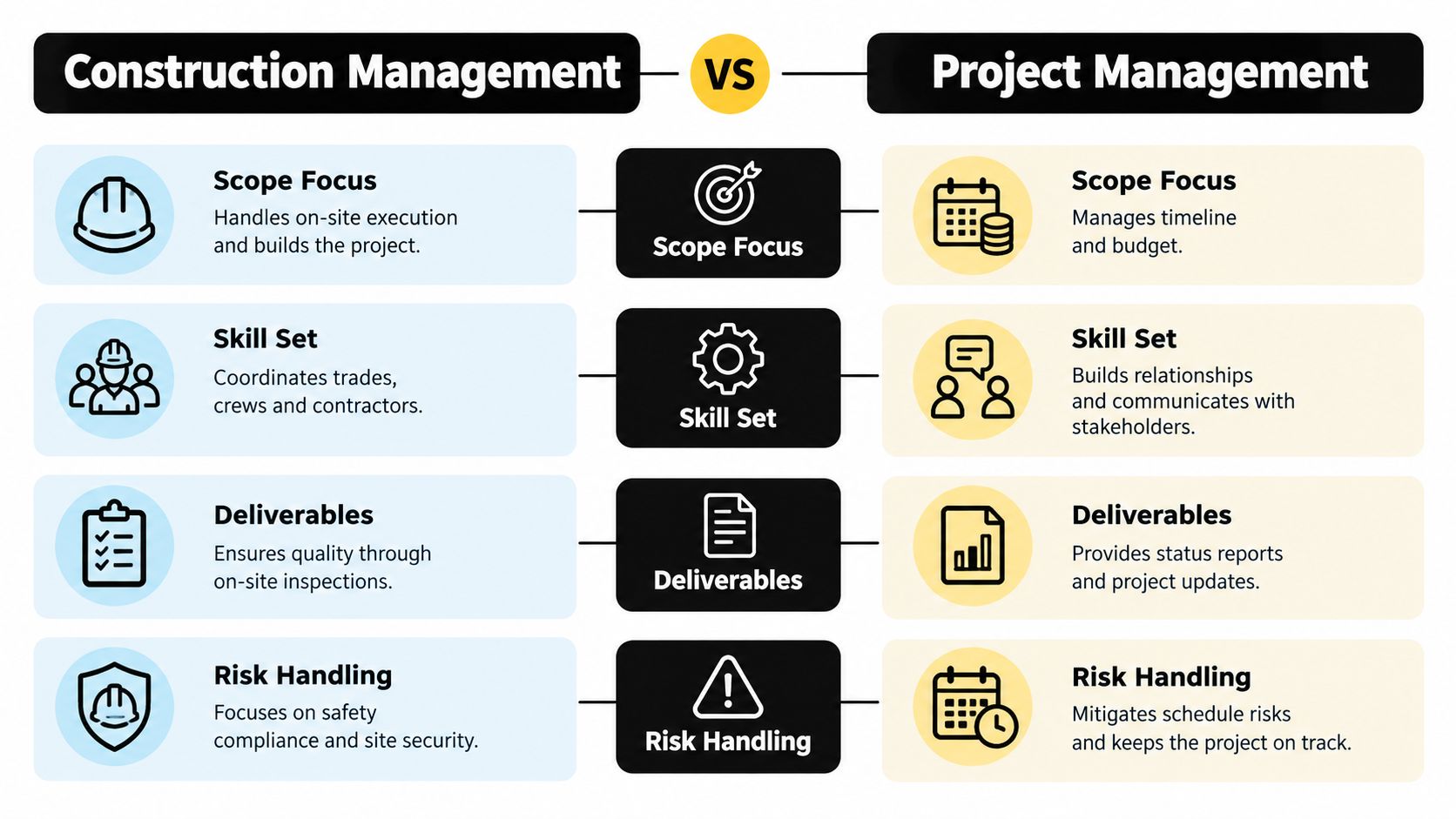
| Criteria | Construction Manager | Project Manager |
|---|---|---|
| Scope focus | Physical construction, site execution, trade sequencing, safety, and quality | Full lifecycle coordination from initiation through closeout |
| Decision authority | Direct control over daily site operations and field responses | Broader control over scope, budget, schedule, contracts, and stakeholder decisions |
| Risk ownership | Jobsite safety, labor coordination, material constraints, and workmanship | Scope changes, budget exposure, schedule risk, procurement, and handoff |
| Primary stakeholders | Subcontractors, installers, suppliers, inspectors, and site personnel | Homeowner, designer, architect, contractor, suppliers, and the wider project team |
| Best performance measure | Reliable execution at the jobsite | Predictable delivery across all project phases |
What each role does well
A construction manager is valuable when the work is active and conditions change. If an existing wall reveals an unexpected plumbing route, the CM can coordinate the plumber, electrician, and carpenter without losing control of the work area. That authority matters during demolition, framing, installation, inspections, and punch-list work.
A project manager is more useful when decisions cross departments or phases. Custom cabinets, specialty hardware, countertops, and tile all require approvals and procurement tracking before installation. A PM keeps those decisions visible to the homeowner and design team instead of allowing them to disappear into separate conversations.
Homeowners researching bathroom renovation project management should look for this same distinction. The relevant question isn't whether the provider uses the term PM. It's whether the service includes the specific coordination your bathroom requires, from selections and ordering to trade access and completion.
How Each Role Handles Residential Remodel Challenges
Residential remodeling compresses many decisions into a small space. A kitchen may involve cabinetry, appliances, plumbing, electrical work, lighting, countertops, backsplash tile, flooring, paint, and finish hardware. Each trade can perform its own work correctly while the overall project still fails if the handoffs aren't controlled.
The construction manager sees the immediate consequences. A cabinet is delivered with a revised filler, the countertop template changes, or the tile installer needs a different substrate. The CM can stop an incorrect installation, resequence trades, and identify a field workaround. That strength is practical, but it doesn't automatically provide visibility into design decisions made before construction began.
The project manager sees the upstream causes. They can tie an approved cabinet drawing to the plumbing plan, confirm product availability before demolition, and make sure a change reaches every affected trade. Their weakness appears when a sudden site condition requires a technical response that depends on real-time field judgment.
The handoffs that cause trouble
Most comparisons describe CM as site execution and PM as full-lifecycle planning, but they rarely answer who owns design-to-build coordination when selections, budgets, and trades overlap. Indeed's overview of construction management versus project management identifies that broad distinction, but a homeowner needs to apply it to actual handoffs.
Watch for these failure points:
- Selection approval: A cabinet layout isn't ready for ordering until dimensions, finishes, hardware, accessories, and appliance clearances are confirmed.
- Procurement timing: A product can be selected correctly yet arrive too late for the trade waiting to install it.
- Field verification: Existing walls and floors can differ from the assumptions in the original design.
- Change control: A requested change should show its effect on cost, scope, lead time, and downstream work before anyone approves it.
A practical resource on tips for a smoother remodel can help homeowners prepare for these decisions, but preparation won't replace ownership. Someone still needs to maintain the current drawings, delivery information, open questions, and approved changes.
Homeowners should also understand how to manage contractors without accidentally taking over the manager's role. Give decisions through one documented channel, ask who is responsible for the next action, and avoid giving separate instructions to individual trades. Otherwise, the field team may work from conflicting versions of the plan.
Real-World Scenarios for South Jersey Homeowners
A straightforward cabinet replacement in Gloucester Township may not need a broad, formal project-management structure. If the kitchen layout stays unchanged, the plumbing and electrical locations remain valid, and the products are ready before installation, the main risks are measurement, delivery, trade sequencing, and finish quality.
In that situation, strong construction management can be enough. The manager confirms site readiness, coordinates removal and installation, protects finished surfaces, checks cabinet alignment, and keeps countertop and backsplash work in the proper order. A full-lifecycle PM isn't useless, but paying for broad oversight may add little if the design and procurement decisions are already settled.
When the project expands
A full gut renovation in Haddonfield is different. Architectural changes, custom cabinetry, countertop fabrication, revised lighting, plumbing relocations, and finish selections create dependencies that begin long before installation. A project manager should own the design approvals, budget decisions, procurement log, and overall schedule, while a construction manager controls daily field execution.
Using only a site-focused manager in that situation can leave the homeowner responsible for chasing designers and suppliers. Using only an office-focused project manager can leave field conflicts unresolved until the next scheduled meeting. The right structure assigns each problem to the person with the authority and information to solve it.
A Cherry Hill bathroom remodel often falls between those examples. The homeowner may want framing completed before finalizing tile, while the vanity, medicine cabinet, plumbing trim, and countertop still need to align. A hybrid model can protect the wider schedule while giving the construction manager authority to adapt the sequence when selections change.
A useful test: The more custom products and overlapping trades your remodel has, the more important it becomes to assign one accountable owner for decisions, even when two people share the work.
For homeowners evaluating local providers, a focused list of South Jersey construction companies can be a starting point. Compare their actual coordination process, not just their service labels.
The Hybrid Workflow Emerging in 2026 Remodels
The strongest residential model often uses project management early and construction management during the build. During discovery and design, the team aligns goals, budget, drawings, selections, specifications, and procurement. Once work begins, the construction manager takes charge of site conditions, trade access, safety, quality, and daily sequencing, while project-level tracking continues in parallel.
This approach fits the direction of construction technology. Coverage of 2026 construction industry trends discusses common data environments, digital project management, AI-driven workflows, and modular processes. For a homeowner, the technology matters only if it improves coordination. A shared dashboard is useful when it shows which cabinet drawing is current, which product is ordered, what remains unresolved, and who must act next.
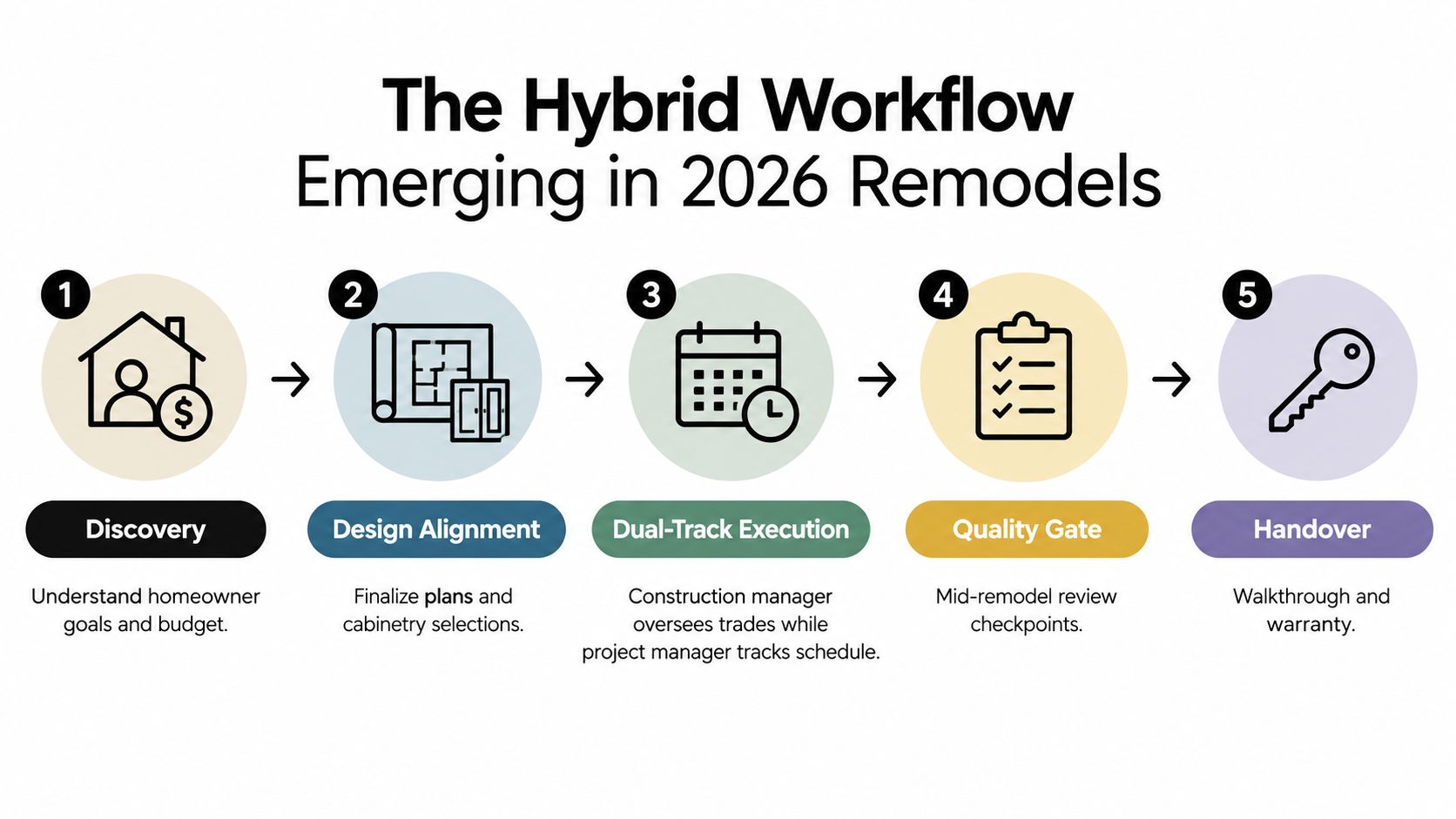
A practical five-stage model
- Discovery: Document the homeowner's goals, constraints, existing conditions, and budget priorities.
- Design alignment: Finalize the layout, cabinet specifications, appliance information, surfaces, hardware, and critical trade requirements.
- Dual-track execution: Let the construction manager direct field operations while the project manager tracks approvals, costs, procurement, and milestone risks.
- Quality gates: Review completed work before it gets covered or followed by another trade. A plumbing or electrical correction is easier before cabinets, tile, or drywall conceal it.
- Handover: Complete the punch list, confirm installed products, collect care information, and resolve outstanding items before the homeowner takes over the space.
The distinction becomes less important when both roles work from connected information. One source reports that the U.S. construction management sector generated $1.5 trillion in economic output in 2022 and employed 2.3 million people in 2023, with employment up 4.1% from 2022. The same source reports that 68% of U.S. construction projects were completed on time when managed by a professional construction manager, while average cost overruns fell to 11.2% from 14.5% in 2019. These figures come from construction management industry statistics, and they reinforce the value of professional coordination without proving that every residential project needs the same structure.
Homeowners can also use latest kitchen design ideas during early planning, but inspiration should become a controlled specification before orders and site work depend on it.
How The Cabinet Coach Coordinates With Both Roles
A homeowner should ask a prospective remodeler five direct questions:
- Who owns the design record? Ask who maintains the approved cabinet drawings, finish schedule, appliance information, and revisions.
- Who checks site conditions? Confirm who verifies walls, floors, plumbing, electrical locations, and measurements before ordering.
- Who controls procurement? Find out who tracks orders, deliveries, damaged items, substitutions, and missing components.
- Who directs trades? Clarify who sets the installation sequence and handles conflicts between cabinet, countertop, tile, plumbing, and electrical work.
- Who approves changes? Require a clear process showing the effect on scope, cost, materials, and timing before work proceeds.
The Cabinet Coach is a mobile cabinet showroom serving South Jersey homeowners, bringing cabinetry, countertops, hardware, and tile selections into the client's planning process. Its workflow uses project-management principles during discovery, design refinement, preliminary estimating, product finalization, and coordination with architects and trades. Construction-management responsibilities then support installation through quality checks, schedule coordination, and on-site problem resolution.

What homeowners should verify
Ask to see how the team handles a cabinet revision after plumbing has been roughed in. Ask who contacts the affected trades, updates the drawings, confirms the product order, and communicates the decision to you. A credible process should make those responsibilities visible before a problem reaches the jobsite.
You should also ask how the team manages a late selection. If tile isn't final, the manager should explain whether that affects substrate preparation, trim details, delivery timing, or the installation sequence. A vague promise to “work it out later” usually transfers risk to the homeowner.
The Cabinet Coach experience reflects the value of bringing design guidance and trade coordination into one connected process. The broader lesson applies to any remodeler you interview. Look for an accountable workflow, documented decisions, and a clean transition from product selection to installation.
Making the Right Choice for Your Renovation
Choose construction management when your design is settled and the central challenge is executing a defined build. Choose project management when the renovation still involves design development, budget decisions, procurement, contracts, multiple stakeholders, or a complicated handoff. Choose a hybrid when both conditions exist, which is common in custom kitchen and bathroom renovations.
Use this checklist before signing:
- Selections: Will cabinetry, tile, hardware, appliances, or plumbing fixtures change after construction begins?
- Trade overlap: Do plumbing, electrical, carpentry, countertop, tile, and cabinet installation depend on one another?
- Custom products: Does the plan include made-to-order items that require careful approval and delivery tracking?
- Existing conditions: Could demolition reveal issues that require design or budget decisions?
- Accountability: Can one named person explain the current plan, next decision, open risk, and responsible party?
- Change orders: Will every proposed change show its effect before the team proceeds?
- Closeout: Who owns punch-list completion, product documentation, warranty information, and final handoff?
The safest choice isn't the broadest title. It's the team that protects decision flow, procurement timing, field execution, and schedule continuity across the whole renovation. In South Jersey, homeowners should evaluate the process behind the business card and insist on clear ownership where design and construction meet.
If you're planning a kitchen or bathroom remodel, The Cabinet Coach offers mobile showroom consultations, cabinetry and finish selection, design coordination, and project guidance that connects planning with installation. Visit The Cabinet Coach to arrange a consultation and discuss which management approach fits your renovation.