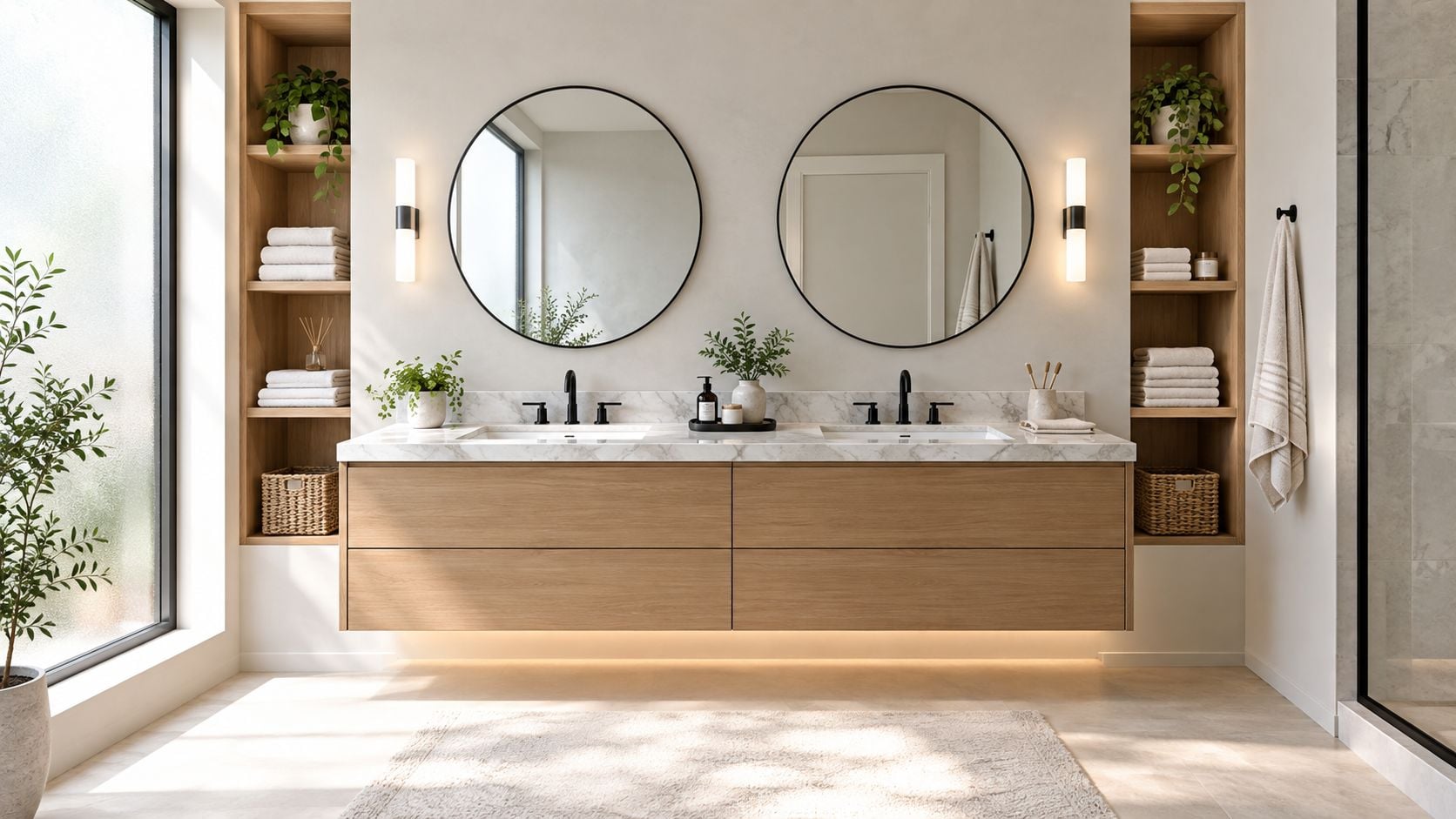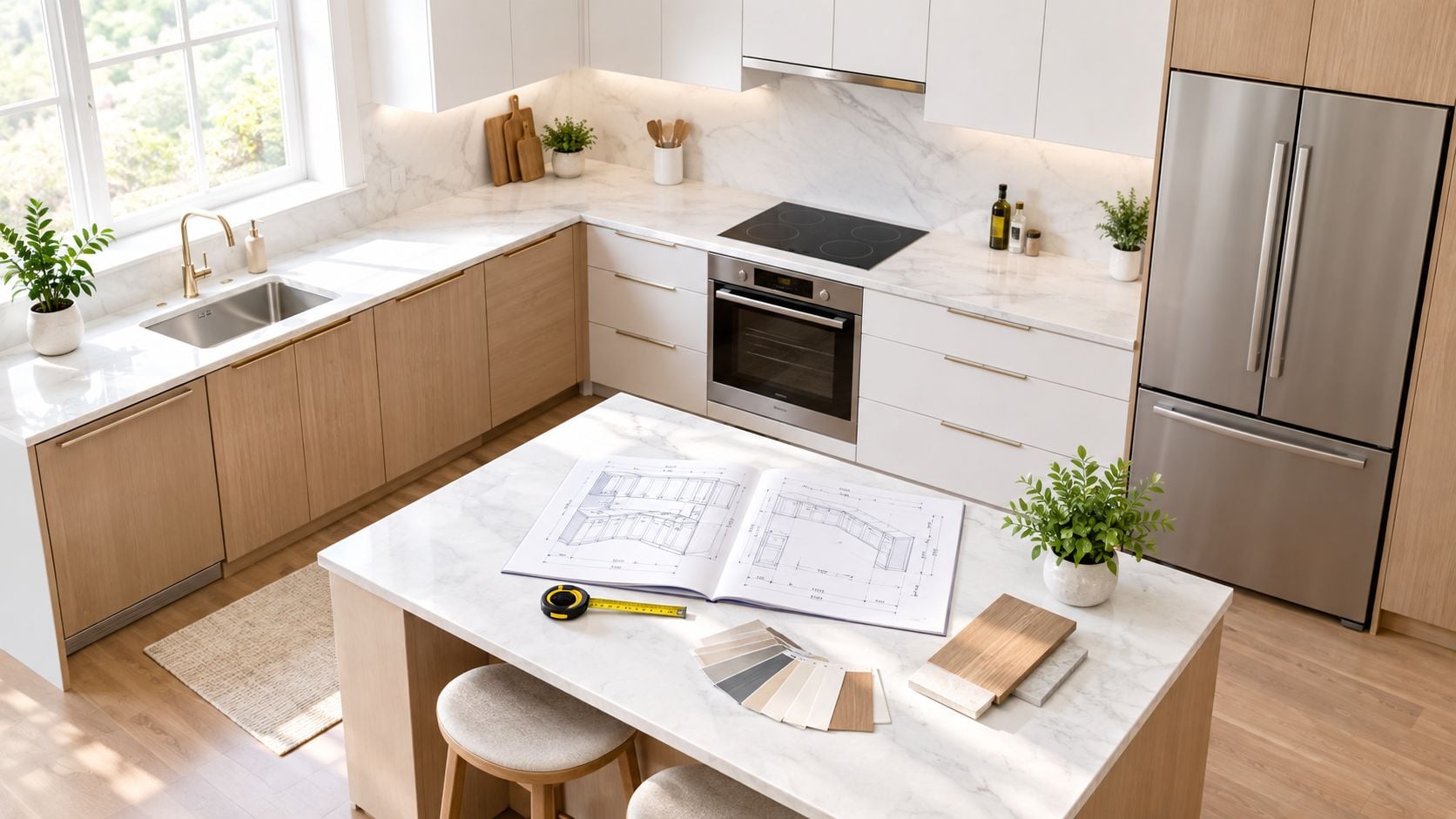
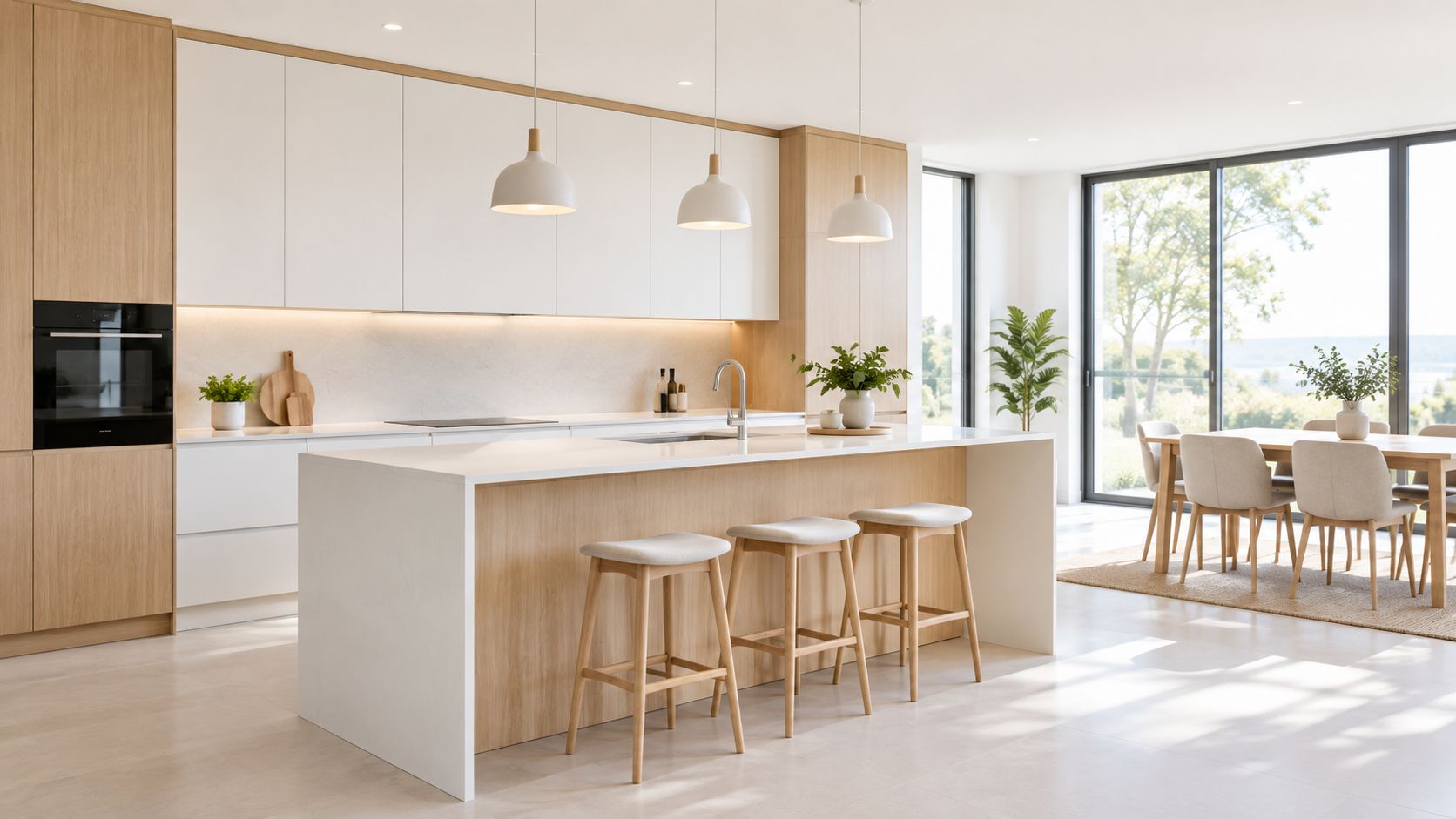
The most popular advice about flat panel kitchen cabinet doors is that their smooth surfaces make them automatically easier to live with. That's only half true. They're easy to wipe, but they can also put fingerprints, water spots, edge damage, and uneven reveals in plain view.
In South Jersey, cabinetry has to handle more than a design photograph. A busy Cherry Hill kitchen may see children, cooking splatter, damp dish towels, open windows, and daily contact around the sink and dishwasher. Flat-panel doors can be an excellent choice, but only when the material, finish, hardware, and household routine work together.
Table of Contents
- Why Flat-Panel Kitchen Cabinet Doors Are Worth Considering
- What Are Flat-Panel Kitchen Cabinet Doors
- Pros and Cons of Flat-Panel Cabinet Doors
- Flat-Panel vs Shaker vs Raised-Panel Doors
- Styling and Pairing Flat-Panel Doors
- Maintenance and Installation Guidance
- When to Choose Flat-Panel Kitchen Cabinet Doors
Why Flat-Panel Kitchen Cabinet Doors Are Worth Considering
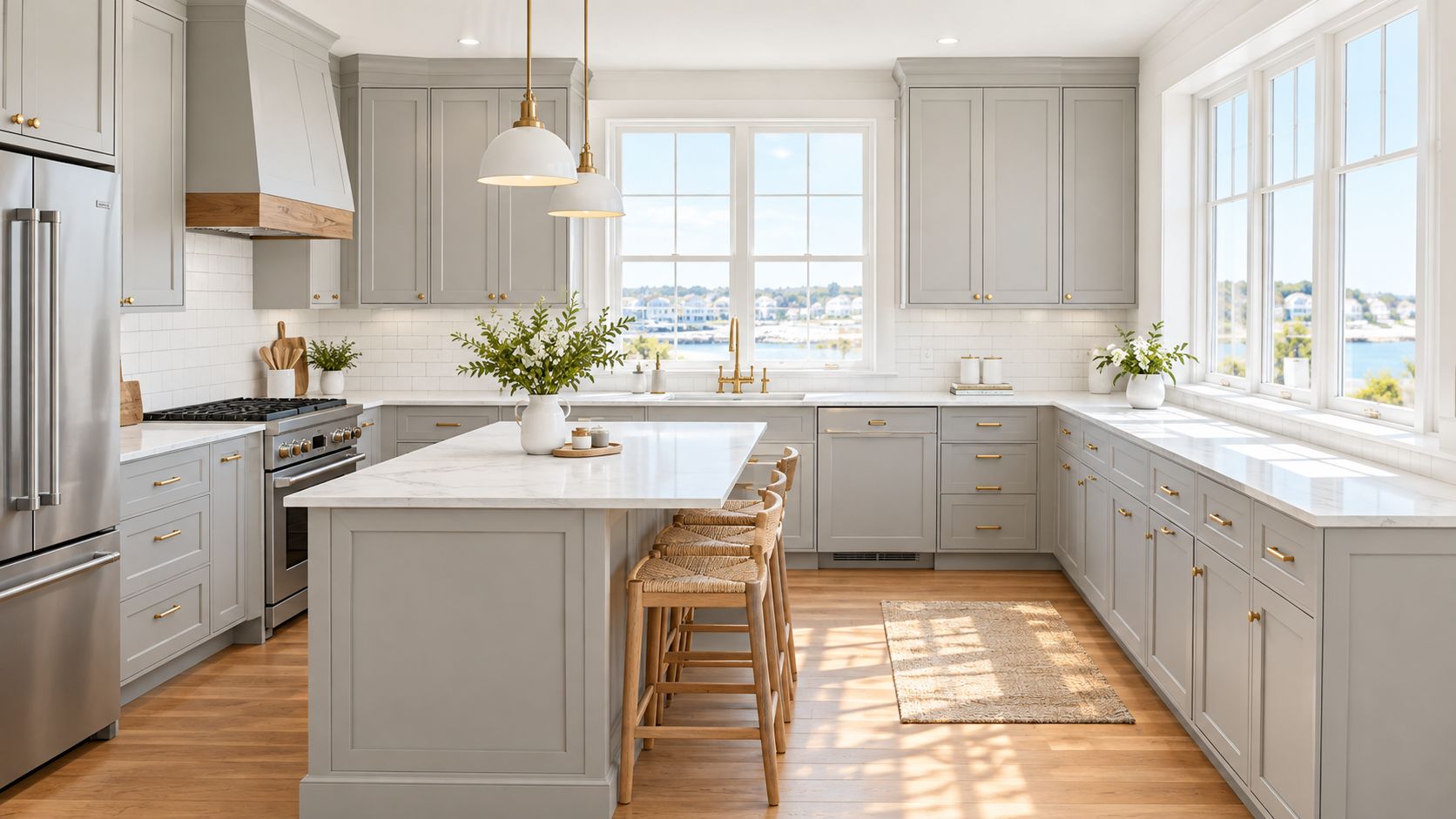
Flat-panel doors earn their reputation through visual restraint. Their broad, uninterrupted faces reduce the lines and shadows created by decorative profiles, which makes a kitchen feel calmer and more connected to nearby living areas. That quality works especially well in open-plan homes, where cabinetry needs to coordinate with flooring, lighting, appliances, and furniture rather than compete with them.
The style also fits naturally with contemporary materials. Matte laminates, woodgrain veneers, painted MDF, integrated appliances, and minimal hardware all benefit from a door face that doesn't introduce extra ornament. The result can feel architectural and furniture-like, particularly with full-overlay cabinetry and carefully aligned drawer fronts.
The look has a real design history
Flat-panel doors didn't appear as an isolated internet trend. A cabinetry industry history places the emergence of the modern style in the mid-1990s, when flat-panel, five-piece doors helped establish the clean-line look that became common in the early 2000s and 2010s. The profile later developed into a contemporary flat-panel product format described as 3/4-inch thick, showing how the aesthetic moved from a design direction into a standardized cabinet offering. Plain & Fancy's history of cabinet door styles provides useful context for that evolution.
The commercial relevance is still clear. A 2026 National Kitchen & Bath Association report, as cited by an industry publisher, found that 69% of 634 surveyed professionals identified flat slab as a growing kitchen cabinet style. The same report found that 72% were specifying panel-faced refrigeration and 85% were specifying panel-faced dishwashers. The industry summary of those NKBA findings connects flat-panel cabinetry with the broader move toward seamless appliance walls.
Beauty should come after household fit
The right question isn't, “Do I like the modern look?” Ask how often the doors will be touched, whether anyone in the home cooks heavily, and how much visible maintenance you'll tolerate. A dark, glossy slab door may look striking in a showroom but demand more wiping than a lighter matte surface.
Practical rule: Choose flat-panel doors for the way your kitchen is used, not just for the way they look in a staged photograph.
What Are Flat-Panel Kitchen Cabinet Doors
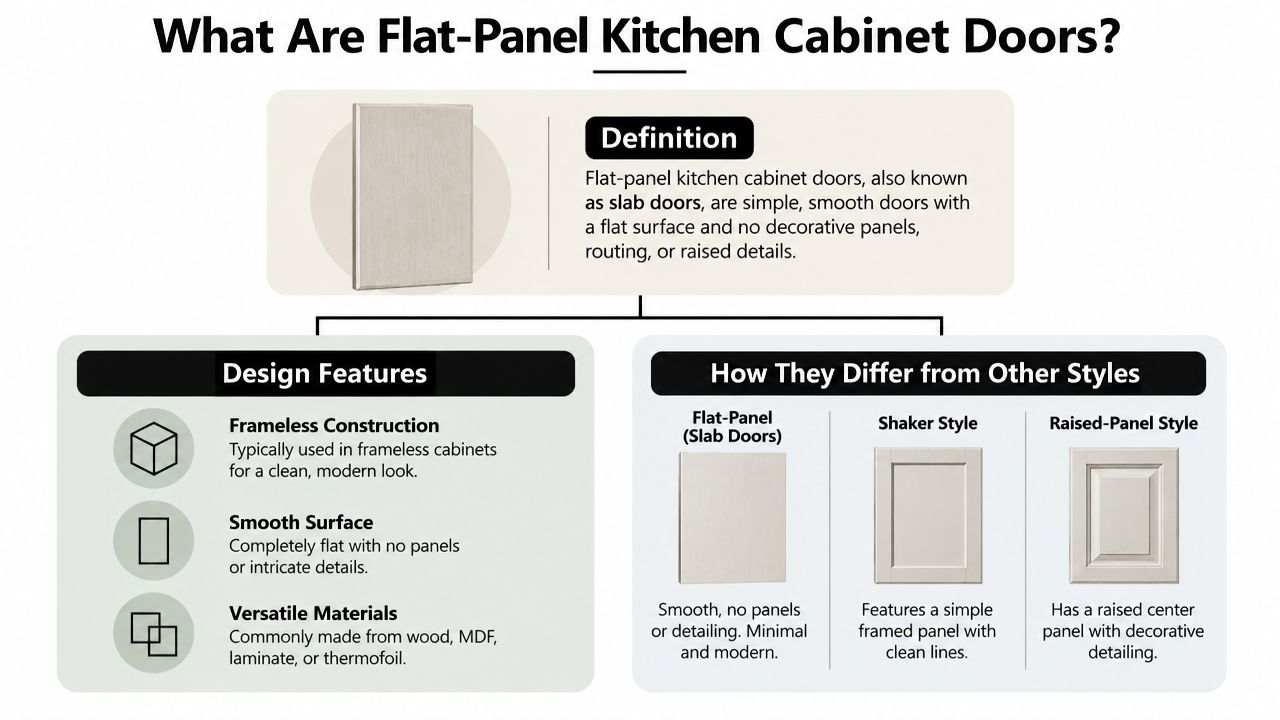
The term flat-panel cabinet door can describe more than one construction. A slab door is usually a single uninterrupted panel with no raised center, decorative molding, or applied frame. A flat-panel recessed door may use rails and stiles around a flat center panel, giving it a subtle frame while preserving the simple face associated with modern cabinetry.
That distinction matters during design consultations. A one-piece MDF slab, a five-piece painted door with a flat center, and a veneered plywood-core door may all look clean from across a kitchen, but they behave differently during finishing, installation, and exposure to moisture.
Construction determines performance
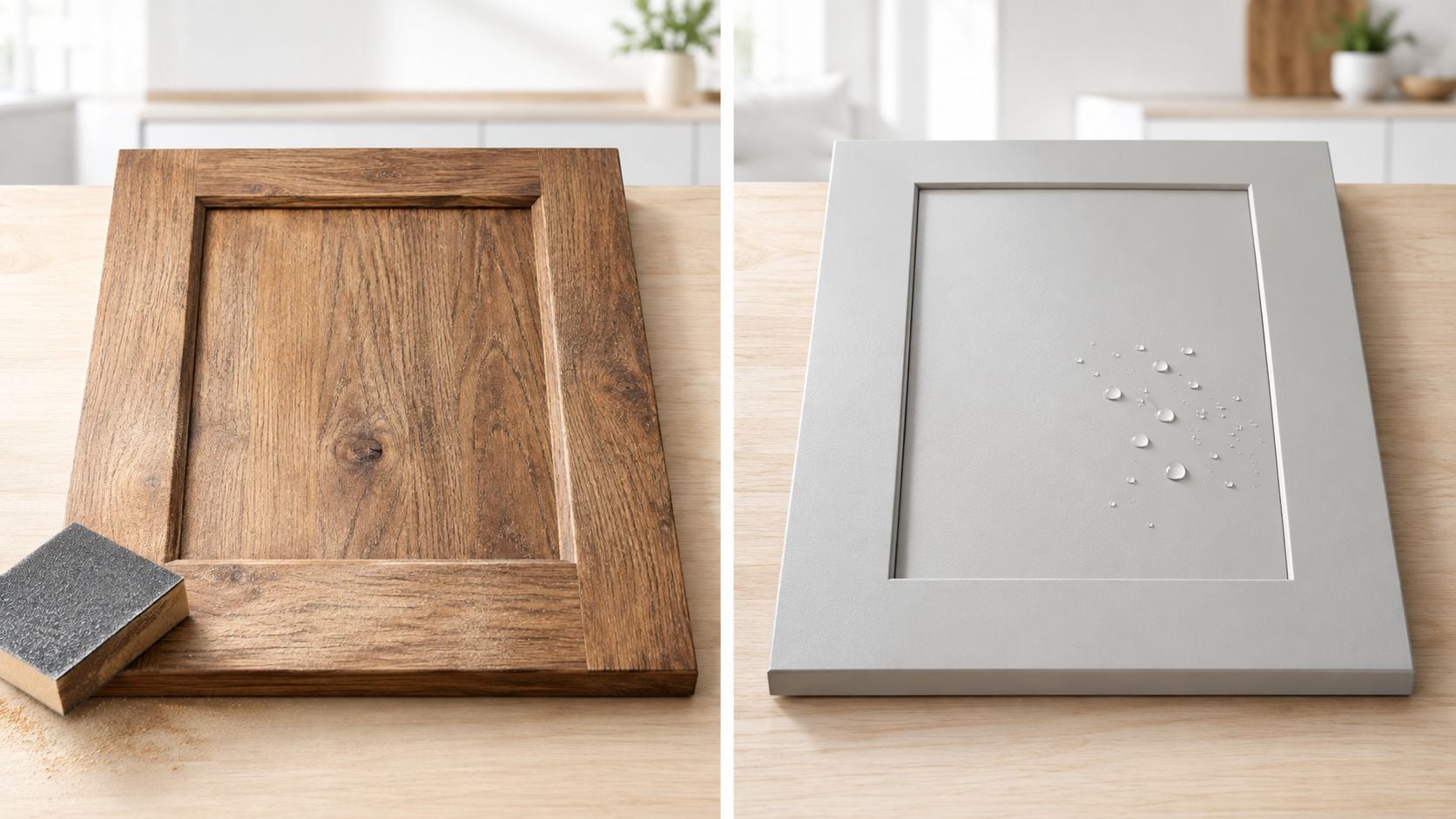
For painted flat-panel doors, MDF is widely used because its dense, uniform face produces a smooth finish without visible wood grain. Its relative stability also helps maintain tight reveals and reduces the chance that seasonal movement will telegraph through an uninterrupted painted surface. In a humid kitchen, however, the edges must be fully sealed. Unsealed MDF can absorb moisture and swell permanently, particularly near sinks and dishwashers. This slab-door material guidance from DG Floors explains why the finish system is as important as the panel itself.
Stain-grade doors usually rely on a veneered MDF or plywood core so the finished face shows natural wood without depending on a large solid-wood panel. Technical guidance describes center panels from 1/4 inch to 3/8 inch, with the thicker 3/8-inch option producing a more substantial feel and sound while appearing the same from the front. Veneer should also be acclimated flat for about 48 hours before installation, and standard MDF and HDF should not be treated as waterproof materials. TaylorCraft Door's MDF and solid-wood core comparison covers those construction considerations.
Finish selection changes the daily experience
Paint creates a continuous color field and works well with contemporary kitchens, but it can make chips and edge wear more noticeable. Veneer reveals grain variation and often gives a warmer, less uniform appearance. Laminate and thermofoil can provide consistent color or woodgrain effects, but heat exposure, repairability, and edge construction need careful review before specification.
For a broader overview of door categories, compare these types of kitchen cupboard doors before choosing a specific sample. Look at the actual door edge, finish sheen, hinge side, and area around the sink, not just the front face.
Pros and Cons of Flat-Panel Cabinet Doors
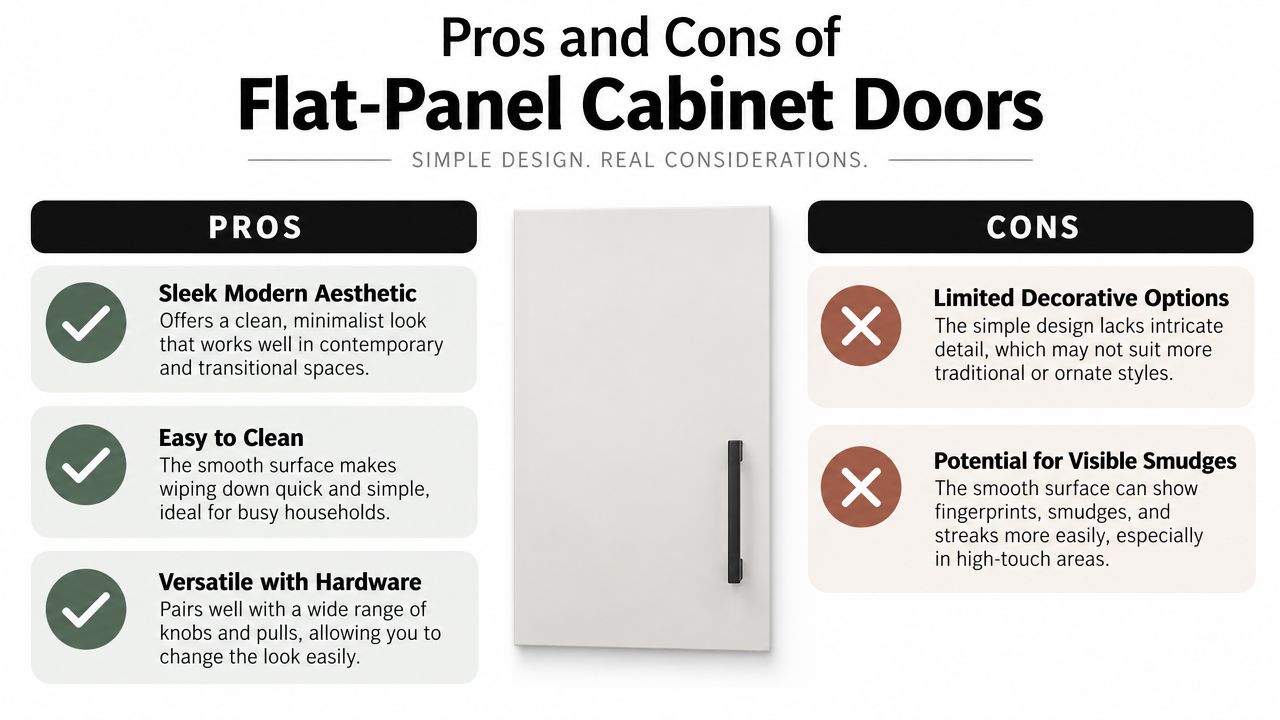
Flat-panel doors solve some practical problems and create others. Their smooth faces have fewer grooves where crumbs and grease can collect, so routine wiping is straightforward. At the same time, the lack of visual texture means a fingerprint or water mark can become the most noticeable feature on the door.
That trade-off becomes sharper with finish sheen. Glossy surfaces reflect light and can emphasize smudges, while very dark colors often make touch marks easier to see. Matte finishes generally soften reflections, but they still need appropriate cleaning and can show oily residue in high-contact areas.
Where the style performs well
The strongest advantages are visual and operational:
- Clean geometry: Broad faces support modern layouts, integrated appliances, and uncluttered sightlines.
- Simple wiping: A flat surface doesn't have the deep profiles found on ornate raised-panel doors.
- Hardware flexibility: Knobs, bar pulls, edge pulls, and push-to-open systems can all work when planned with the overlay and door proportions.
- Material range: Painted MDF, wood veneer, laminate, and other engineered constructions allow the appearance and performance to be matched to the project.
- Consistent repetition: Matching doors and drawer fronts create a strong rhythm across long cabinet runs.
Flat-panel doors also make a useful backdrop for contrasting elements. A natural wood slab can warm a white room, while a painted door can allow a stone countertop or metal appliance finish to carry more attention.
Where homeowners feel the compromise
The main drawback is not that the doors are difficult to clean. It's that they can make cleaning more visible. Families who regularly open doors with wet or greasy hands may find themselves wiping more often, especially around trash pull-outs, the refrigerator, and the area beside the range.
The minimal design also demands accurate installation. Uneven cabinet boxes, inconsistent overlays, or poorly aligned hinges stand out because the door fronts offer no decorative detail to disguise small errors. Push-to-open hardware can preserve a handleless appearance, but it depends on accurate alignment and consistent adjustment.
| Flat-Panel Door Trade-offs | Practical effect |
|---|---|
| Pros | Sleek appearance, easy access to the full door face, flexible hardware choices, and straightforward surface wiping |
| Cons | Fingerprints and water spots may be conspicuous, decorative variety is limited, and alignment defects are easier to see |
The style is often described as low maintenance, but that phrase needs qualification. Low profile isn't the same as low attention.
Flat-Panel vs Shaker vs Raised-Panel Doors
The most useful comparison isn't “modern versus traditional.” It's how much visual structure you want, how the door will be handled, and whether the architecture of the home calls for a crisp or more layered treatment.
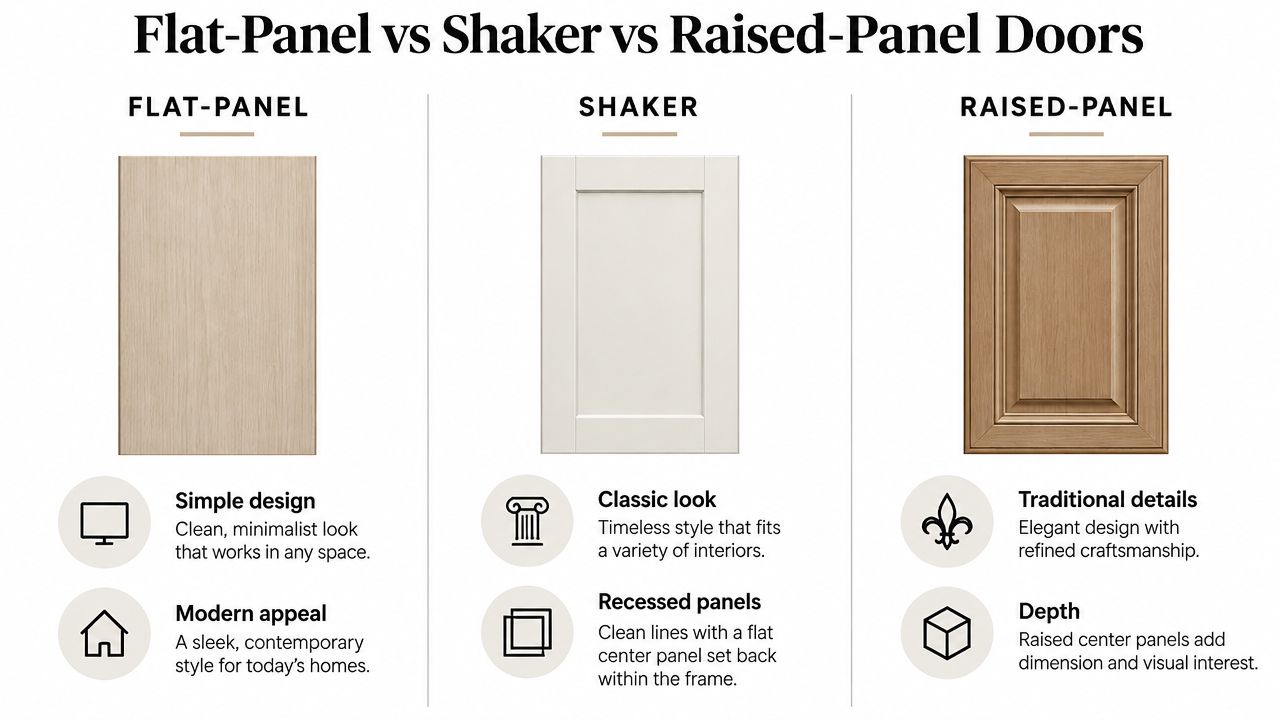
Flat-panel doors provide the quietest face. Shaker doors add a frame and recessed center, which creates shadow lines without becoming ornate. Raised-panel doors introduce shaped profiles and depth, making them a natural fit for kitchens with more traditional millwork, furniture details, or formal finishes.
Three styles, three different demands
| Style | Aesthetic | Maintenance | Best For |
|---|---|---|---|
| Flat-panel | Smooth, streamlined, contemporary | Easy to wipe, but touch marks can stand out | Modern kitchens, integrated appliances, and open-plan layouts |
| Shaker | Recessed center with a simple frame | More edges and corners to clean, but forgiving visually | Transitional kitchens and homes blending traditional and modern elements |
| Raised-panel | Layered profiles with pronounced depth | More detailed surfaces and profiles require closer cleaning | Classic kitchens with traditional architecture and decorative millwork |
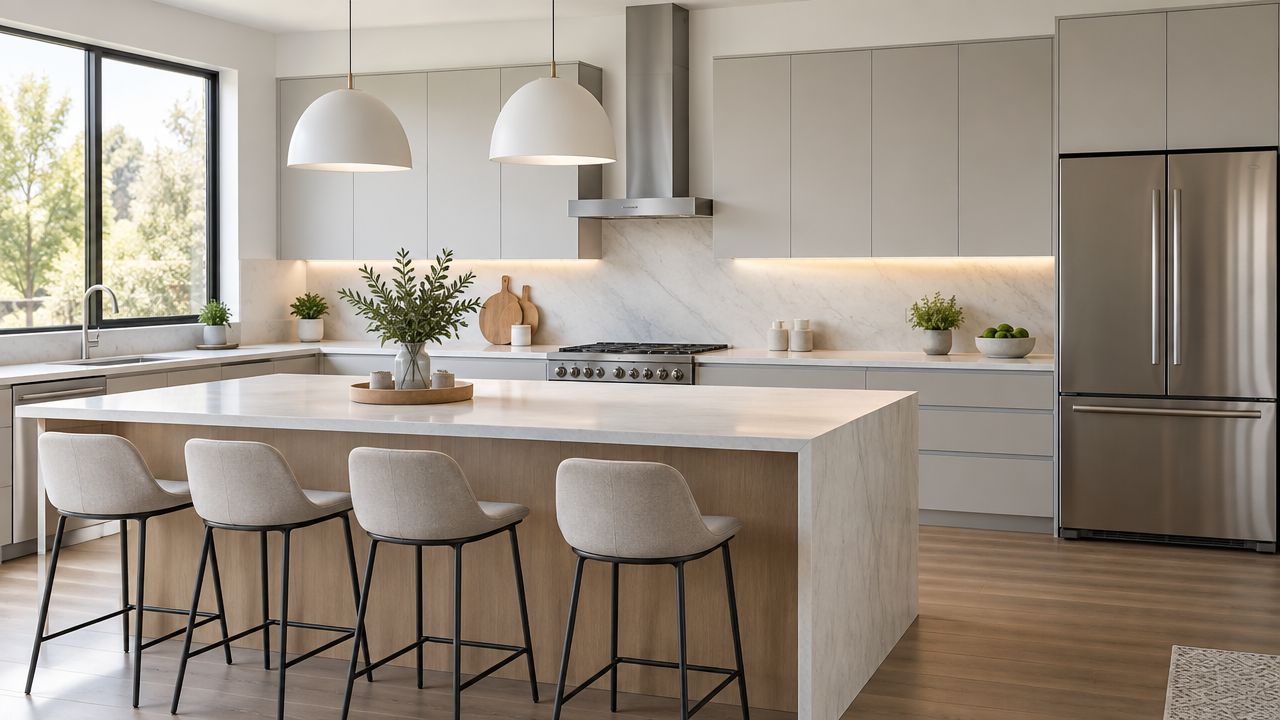
Flat-panel doors work particularly well when the kitchen needs to feel visually lighter. They suit slab backsplashes, waterfall-style island edges, concealed appliances, and restrained lighting. Shaker doors are often the safer choice when a homeowner wants flexibility over time because their profile can support both contemporary and traditional hardware. Raised-panel doors bring character through the door itself, so they may reduce the need for other decorative elements.
Hardware changes the comparison
Hardware can either reinforce the door style or deliberately soften it. A long horizontal pull emphasizes the slab's geometry, while a small knob introduces a more familiar furniture note. Push-to-open hardware removes visible pulls, but it places greater importance on door alignment and on how users naturally open the cabinets.
For layout, spacing, and pull placement, this guide to hardware selection for cabinets offers useful planning context from Jennifer Gilmer Kitchen & Bath. The selection should follow the hand movements in the room, not only the finish board.
A South Jersey colonial with traditional trim may feel more coherent with Shaker or raised-panel doors, while a renovated ranch or townhouse may benefit from the continuous lines of flat-panel cabinetry. To compare more profiles before ordering samples, review these cabinet door styles.
Styling and Pairing Flat-Panel Doors
Flat-panel doors look their best when the rest of the kitchen respects their simplicity. That doesn't mean every surface needs to be plain. It means each contrasting element should have a job, such as adding warmth, defining the island, or creating a visual stop at the range wall.
A common South Jersey approach is painted perimeter cabinetry with a wood-toned island. Flat-panel doors make that contrast especially clean because the color change happens across broad, uninterrupted faces. Light oak or walnut veneer can add texture without introducing a decorative cabinet profile, while a muted painted finish can keep the room from feeling overly busy.
Coordinate the main surfaces
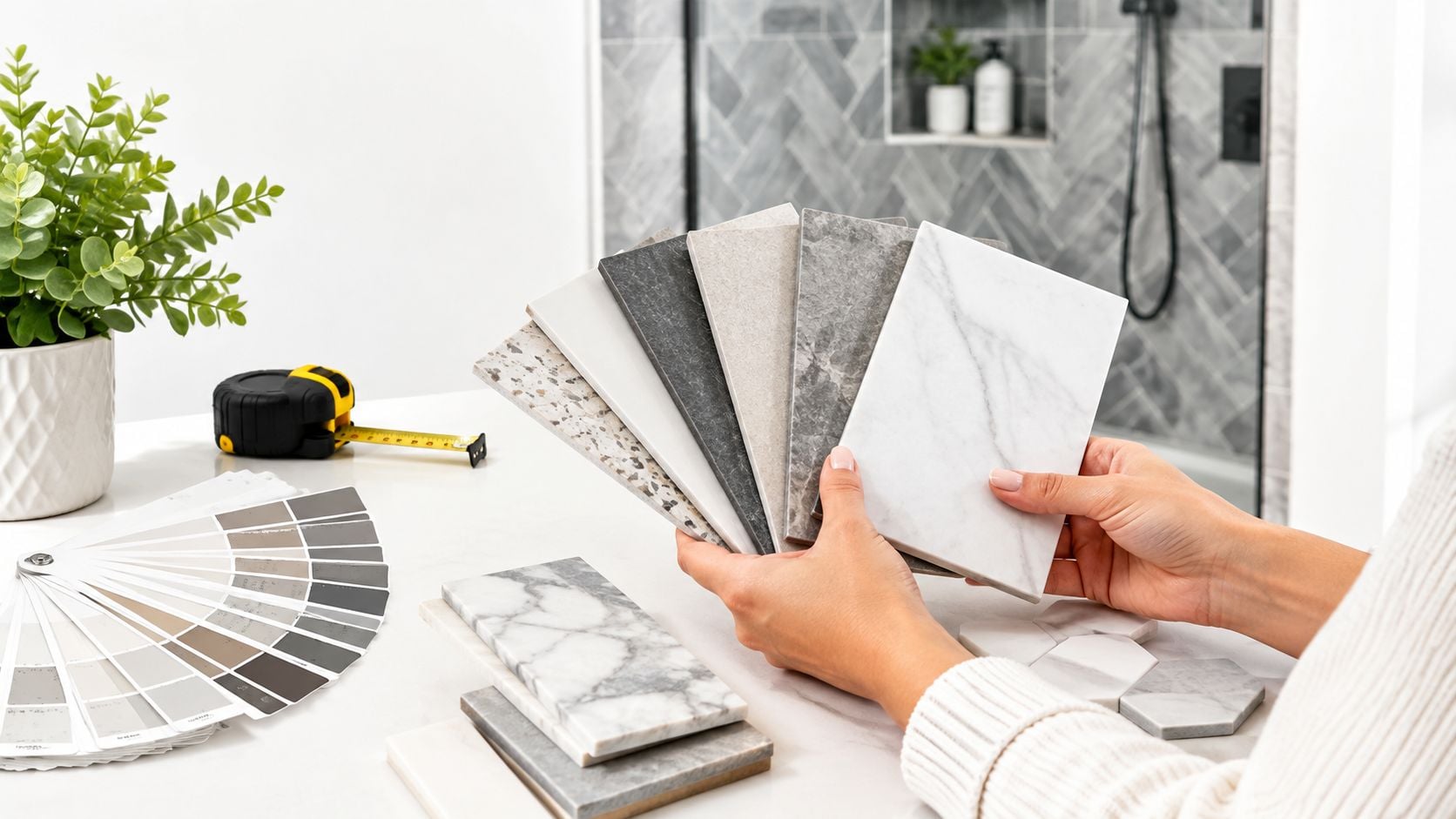
Start with the cabinet finish, then test the countertop and backsplash beside a physical door sample. White or pale flat-panel doors can support darker flooring, but the undertone matters. Cool white cabinetry may fight warm beige flooring, while a warmer paint can connect more naturally with oak, natural stone, or brass hardware.
For additional guidance on best flooring for white cabinets, compare the floor sample in both daylight and the artificial light used at night. A finish that appears balanced in a showroom can shift noticeably under recessed lighting or pendant fixtures.
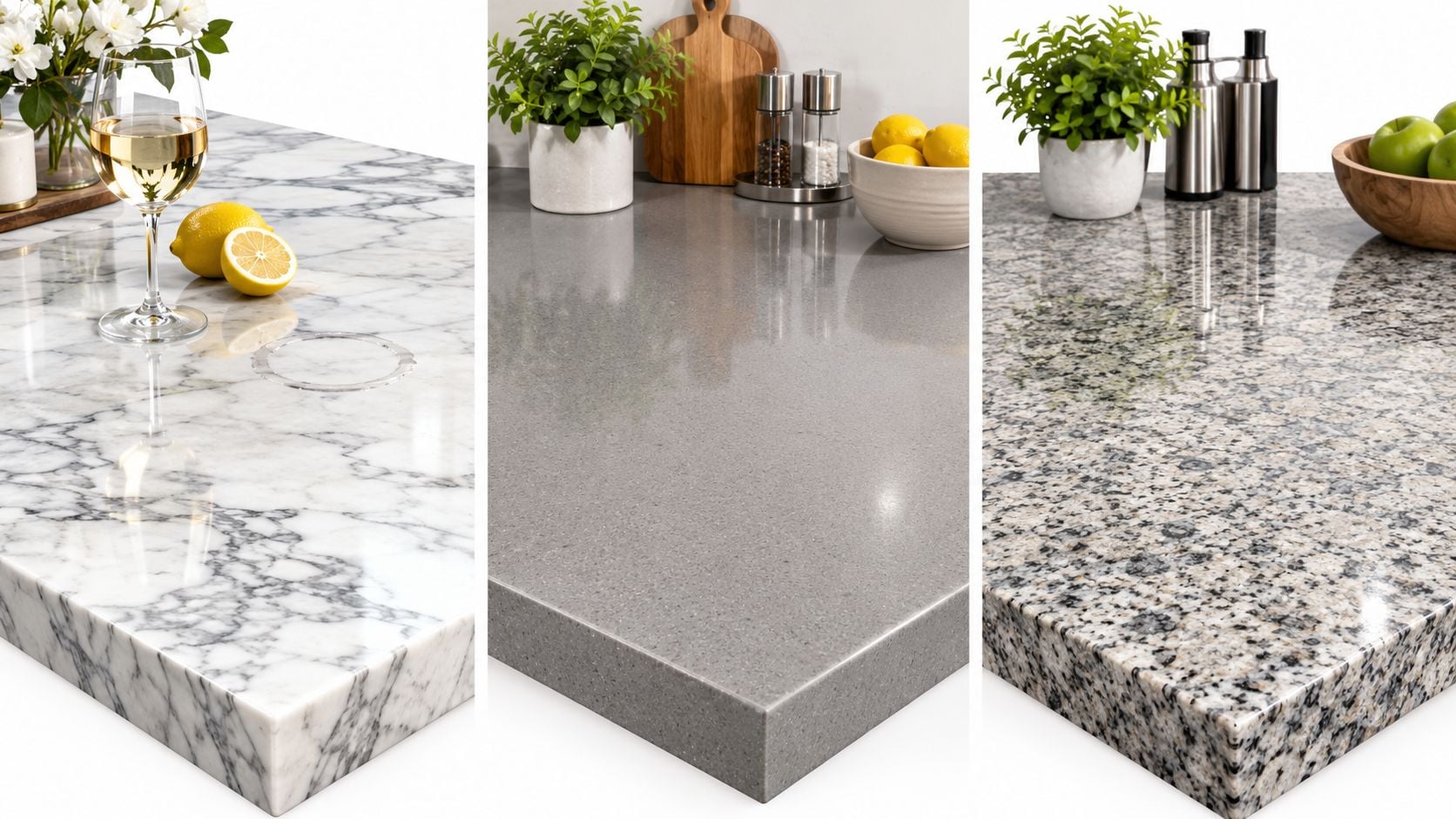
The countertop should provide either controlled contrast or a quiet continuation. A strongly veined stone already supplies movement, so pairing it with a bold backsplash and high-contrast cabinet color may overwhelm the room. Conversely, a restrained countertop can leave room for more expressive tile, lighting, or hardware.
Match hardware to use, not only appearance
Matte black hardware sharpens a modern scheme, brushed brass adds warmth, and stainless or polished nickel can connect with appliances and plumbing. Long pulls make wide drawers comfortable, while smaller doors may need knobs or shorter pulls to avoid a crowded appearance.
Handleless designs can be attractive in a compact kitchen because they remove interruptions along the cabinet run. They also require a realistic conversation about how doors open when hands are wet, full, or occupied. A shallow edge pull or integrated recess may offer a better compromise than a completely touch-operated system.
Use the countertop, cabinet, and backsplash together rather than selecting each independently. This countertop and cabinet combinations guide can help organize those decisions before you commit to a full finish package.
The most successful flat-panel kitchens usually contain one deliberate focal point. It might be a walnut island, a dramatic range hood, a textured backsplash, or a carefully chosen pendant. The doors provide the quiet field that allows that feature to stand out.
Maintenance and Installation Guidance
Flat-panel cabinetry rewards disciplined installation and sensible cleaning. Its broad surfaces are quick to wipe, but they also show streaks and alignment problems without much visual distraction. A good result depends on what happens before the doors are hung, especially around moisture sources.
Protect the finish during daily use
Use a soft microfiber cloth and a mild cleaner that's compatible with the manufacturer's finish. Spray the cloth rather than flooding the door, and dry the surface afterward around the sink and dishwasher. Avoid abrasive pads, aggressive degreasers, and excessive water, which can dull a finish or work into vulnerable edges.
Pay particular attention to the touch zones. Refrigerator panels, trash pull-outs, sink-base doors, and the cabinet beside the range usually need more frequent wiping than upper cabinets. If fingerprints are a concern, compare matte and textured samples under strong side lighting before choosing a final color.
Treat edges and wet zones seriously
MDF is appropriate for many painted applications, but it must be sealed completely. A small unsealed edge can become a larger problem after repeated moisture exposure. Veneered MDF and plywood cores can offer a stable stain-grade appearance, but standard MDF and HDF still aren't waterproof, so wet-zone specifications should be reviewed rather than assumed.
Ask the installer how the sink cabinet, dishwasher opening, end panels, and exposed toe-kick areas will be protected. The material choice matters, but so do the finish, edge treatment, ventilation, and the way water is managed during everyday use.
Installation precision is part of the design
Before installation, confirm the door position, overlay, hinge boring, and reveal expectations. Concealed soft-close hinges offer adjustment, but they can't correct a cabinet box that's badly out of square or a door ordered to the wrong dimensions.
Use a clear checklist:
- Confirm the sample: Approve the actual finish, edge, sheen, and color in the kitchen lighting.
- Inspect the boxes: Correct uneven or out-of-square cabinet runs before hanging the fronts.
- Plan hardware locations: Mark pulls, knobs, edge profiles, and push-to-open components before drilling.
- Adjust the reveals: Check spacing across doors and drawer fronts from several viewpoints.
- Protect during construction: Keep protective film and clean coverings in place until nearby work is complete.
For homeowners deciding between painted and stained options, this guide to paint and stain cabinets is a useful reference. The Cabinet Coach can also help coordinate cabinet, surface, and hardware decisions through its mobile showroom process, which is practical when samples need to be reviewed in the actual home.
When to Choose Flat-Panel Kitchen Cabinet Doors
Flat-panel doors are a strong fit when you want clean lines, low visual noise, and a contemporary relationship between cabinetry and appliances. They work especially well in open-plan kitchens, compact rooms, and remodels where a calm cabinet face can make the layout feel more continuous.
They're also a sensible choice for homeowners willing to choose materials carefully. Painted MDF can provide a consistent face, while veneered construction can add warmth and reduce the dependence on a solid-wood center panel. In either case, moisture protection around sinks and dishwashers should be treated as a specification, not an afterthought.
Lifestyle should make the final decision
A household with young children, frequent entertaining, or heavy daily cooking may dislike the visibility of fingerprints more than it enjoys the minimalist appearance. A rental or investment property may also benefit from a more forgiving door profile and finish, particularly when frequent occupants won't follow a careful cleaning routine.
Shaker doors can be a better compromise when you want a modern foundation with more visual tolerance. Raised-panel doors may suit a home where traditional millwork already defines the interior. The right choice depends on the architecture, the users, the finish, and the level of upkeep you'll accept.
Flat-panel doors are an aesthetic decision with a maintenance consequence. Decide whether you want to manage that consequence before you order the doors.
For a broader decision framework, use this guide on how to choose kitchen cabinets. A local design consultation should review the door sample beside your flooring, countertop, backsplash, appliances, and the areas where hands will touch the cabinetry most often.
The Cabinet Coach helps South Jersey homeowners compare flat-panel, Shaker, and raised-panel cabinetry alongside countertops, hardware, tile, and finish samples through a mobile showroom experience. Visit The Cabinet Coach to schedule a complimentary video consultation and discuss a cabinet plan suited to your home, climate, and daily routine.